
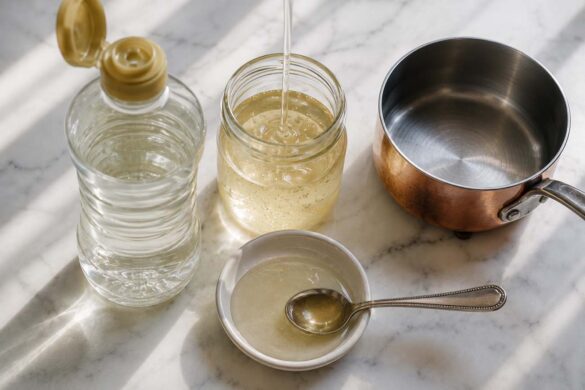
You find a bottle of Karo syrup in the back of the pantry with a best-by date that passed a while ago, or the syrup has gone cloudy and hard to pour. Does corn syrup go bad?
The short answer: Corn syrup rarely goes bad in a food safety sense. Its high sugar concentration and low water content create an environment that bacteria and mold cannot easily grow in, so a sealed, properly stored bottle remains safe well beyond its printed date. Karo’s own guidance describes the product as safe to eat indefinitely as long as nothing has contaminated it. The most common change over time is crystallization, where the syrup becomes thick, hazy, or develops sugar crystals. This is a normal physical change, not spoilage, and can usually be reversed by gentle warming. The genuine discard signs are mold, an off or alcoholic smell, and cloudiness combined with foaming.
For a full overview of how baking staples and sweeteners compare on shelf life, visit our Complete Food Storage Guide.
📋 Corn Syrup: At a Glance
- Unopened: best quality for about 3 years per general industry guidance. Safe well beyond that if sealed and undamaged.
- Opened: remains safe and usable for years when tightly sealed and stored in a cool, dry place. Best flavor and consistency within 1 to 2 years of opening.
- Crystallization is not spoilage. Hard or hazy syrup from sugar crystals can usually be fixed by gently warming the bottle in hot water.
- Refrigeration is not required. Cold temperatures actually make crystallization more likely, not less.
- Consult a pediatrician before giving corn syrup to infants under 12 months. This is the same precaution given for honey, due to a possibility of Clostridium botulinum spores in this unsterilized product.
- Karo Light and Karo Dark do not contain high fructose corn syrup per Karo’s own FAQ, despite the similar name. They are made from regular corn syrup.
Key Takeaways
- Corn syrup is one of the most shelf-stable liquid sweeteners. Its low water activity puts it in the same general category as honey and maple syrup for resistance to microbial growth, though its storage needs differ slightly from maple syrup.
- The best-by date is a quality marker, not a safety deadline. Karo states the product is safe to eat indefinitely, and opening the bottle for the first time does not change or shorten that shelf life.
- Crystallization is reversible. Submerging the sealed bottle in hot water and letting it sit for several minutes, or gently warming the syrup in a saucepan, will typically dissolve the crystals and restore a smooth consistency.
- Always consult a pediatrician before giving corn syrup to an infant under 12 months. A 1982 FDA survey found botulism spores in a small percentage of samples, prompting a manufacturing change; a follow-up 1991 survey of 738 samples found none. A 2009 AAP report notes no proven case from corn syrup, but manufacturers still cannot guarantee any individual bottle is spore-free, so the precaution stands regardless.
- Light and dark corn syrup are not interchangeable with high fructose corn syrup. Karo Light and Karo Dark, the products used for baking, contain no high fructose corn syrup according to Karo’s own FAQ.
How Long Does Corn Syrup Last?
Corn syrup is made by breaking down cornstarch into a syrup composed primarily of glucose, along with smaller amounts of other sugars. Like honey and maple syrup, its long shelf life comes from its sugar concentration, which leaves very little available water for bacteria, yeast, or mold to use for growth.
| Status | Shelf Life | Notes |
|---|---|---|
| Unopened, cool dry pantry | About 3 years for best quality; safe well beyond | Best-by date reflects quality, not safety |
| Opened, tightly sealed, cool dry pantry | Indefinite if properly sealed; best within 1 to 2 years | Opening the bottle does not start a new shelf-life clock |
| Crystallized but otherwise unspoiled | Still usable | Warm gently to dissolve crystals before using |
| Cloudy, foamy, or off-smelling | Discard | These signs indicate actual contamination, not normal aging |
Shelf life guidance per Karo’s official FAQ, which states the product is safe to eat for an indefinite period whether opened or unopened, provided nothing has contaminated it. General industry guidance recommends about 3 years in the pantry for peak quality. Light yellowing of light corn syrup over time is normal and not a spoilage sign.
Why Corn Syrup Almost Never Goes Bad
Low Water Activity and Sugar Concentration
Corn syrup is produced through an enzymatic process that converts cornstarch into a blend of sugars, primarily glucose, along with maltose and longer glucose chains. The finished syrup has very little free water because most of it is tightly bound to the dissolved sugar molecules. This is the same water activity principle that makes honey and other high-sugar syrups inhospitable to bacteria, yeast, and mold: there simply is not enough available moisture for these organisms to survive and reproduce.
Karo’s own FAQ reflects this directly: their corn syrup is safe to eat for an indefinite period, whether the bottle has been opened or not, as long as no contamination has occurred. Opening the bottle for the first time does not reset or shorten the shelf-life clock, since the syrup’s resistance to spoilage comes from its chemistry rather than from the seal alone.
The one quality change that does reliably occur over time is crystallization. As corn syrup sits, especially with exposure to temperature swings, some of the dissolved sugar can come out of solution and form crystals, making the syrup look cloudy, hazy, or grainy and feel thicker or harder to pour. This is a purely physical change in how the sugar molecules are arranged, not a chemical breakdown or microbial contamination, and it does not make the syrup unsafe.
How to Tell If Corn Syrup Has Gone Bad
Real Problems vs. Non-Problems
Crystallization (not a problem): If the syrup looks grainy, has visible sugar crystals, or has thickened into a hard or semi-solid mass, it has crystallized due to age or temperature fluctuation. This is safe and reversible. Warm the sealed bottle in a bowl of hot water for several minutes, or transfer the syrup to a saucepan and warm gently over low heat, stirring until the crystals dissolve and the texture is smooth again.
Yellowing (not a problem): Light corn syrup can develop a slightly more yellow tint over long storage. This color shift alone is normal and does not indicate spoilage.
Cloudiness or haziness combined with other signs (a problem): Mild haziness from crystallization is normal, but cloudiness accompanied by foaming, bubbling, or an off smell is different and indicates actual contamination or fermentation. Discard syrup that shows this combination of signs.
Off or alcoholic smell (discard): Fresh corn syrup has a mild, neutral, faintly sweet smell. A sour, fermented, or alcohol-like odor means something has gotten into the bottle and begun fermenting. Discard immediately.
Mold (discard): Any visible fuzzy growth, regardless of color, means discard the entire bottle. Mold is rare in properly sealed corn syrup but can develop if water or food particles were introduced via a contaminated spoon or pouring spout.
Off taste (discard): If the syrup passes the smell and visual checks but tastes wrong, sour, or otherwise off compared to its usual mild sweetness, do not use it.
What does not matter: A best-by date that has simply passed is not, by itself, a reason to discard corn syrup. Karo’s guidance and general food science both support that an intact, properly stored bottle remains usable well past its printed date.
How to Store Corn Syrup Properly
Storage Best Practices
Cool, dry pantry away from direct sunlight. Room temperature storage in a kitchen cabinet or pantry shelf is ideal. Avoid areas that experience significant temperature swings, such as next to the stove, oven, or a sunny window, since fluctuating temperatures are one of the main triggers for crystallization.
Seal the bottle tightly after every use. Air and moisture exposure are the two factors most likely to introduce the contamination that can actually cause corn syrup to spoil. A loose or improperly closed cap allows both in.
Refrigeration is not necessary, and can backfire. Karo and other sources confirm refrigeration is not required for corn syrup. Cold temperatures can actually make the syrup thicker and more prone to crystallizing, and it becomes very difficult to pour straight from the fridge. If you live in an especially hot, humid climate, refrigeration is an option, but it is a tradeoff against convenience and crystallization risk rather than a necessity for safety.
Freezing is possible but changes the texture. Corn syrup does not freeze solid because of its sugar content. Instead, it becomes thicker and more gelatinous. This is reversible by bringing the syrup back to room temperature, but freezing offers no real shelf-life benefit given how stable corn syrup already is at room temperature, so it is rarely necessary.
Use clean, dry utensils. Never dip a used spoon or a utensil that has touched other ingredients into the bottle. This is the most common way contaminants and excess moisture get introduced, which is what eventually leads to genuine spoilage.
Store away from strong odors. Like other syrups, corn syrup can pick up nearby smells if the seal is imperfect. Keep it away from onions, spices, and cleaning products for best flavor retention.
How to Fix Crystallized Corn Syrup
Reversing Crystallization
Hot water bath (easiest method): Place the sealed bottle in a bowl or sink of hot tap water for 10 to 15 minutes. Check periodically and swirl the bottle gently. The warmth will dissolve the crystals back into solution.
Stovetop method: For more stubborn crystallization, pour the syrup into a small saucepan and warm over low heat, stirring continuously, until the crystals fully dissolve and the syrup returns to a smooth, pourable consistency. Let it cool before transferring back to its original container or using it in a recipe.
Prevention going forward: Once dissolved, crystallization can recur if the syrup experiences the same temperature swings again. Store it consistently at a stable room temperature in a tightly sealed container to minimize the chances of it happening repeatedly.
Corn Syrup, High Fructose Corn Syrup, and Infant Safety
These are two genuinely different topics that frequently get conflated in online searches, and it is worth separating them clearly.
Corn syrup vs. high fructose corn syrup: Per Karo’s official FAQ, regular corn syrup (the kind used for baking, labeled Karo Light and Karo Dark) and high fructose corn syrup are not the same product. High fructose corn syrup starts as regular corn syrup but is then further processed with enzymes to convert a portion of its glucose into fructose. Karo Light and Karo Dark, the products typically called for in baking recipes, contain no high fructose corn syrup, a change Karo made in response to consumer demand after originally including it in some products in the 1970s.
The infant botulism caution: The precaution here is straightforward: do not give corn syrup to an infant under 12 months without first consulting a pediatrician. Corn syrup, honey, and other unsterilized food products carry a possibility of containing Clostridium botulinum spores, which can be dangerous for infants under 12 months whose digestive systems have not yet developed the protective gut flora that older children and adults have.
The history here is worth knowing in full. In 1982, an FDA market survey found Clostridium botulinum type B spores in approximately 0.5% (5 of 961) of previously unopened retail samples of light and dark corn syrup. In response, the manufacturer changed its production process. A follow-up 1991 FDA market survey of 738 unopened retail corn syrup samples (354 light, 271 dark) found no Clostridium botulinum spores in any of them. A 2009 American Academy of Pediatrics committee report states that no case of infant botulism has ever been proven to be attributable to consumption of contaminated corn syrup specifically, though the report also notes that manufacturers cannot guarantee any individual bottle is completely free of spores, since corn syrup is not a sterile product.
Because of this, Karo and pediatric guidance both continue to recommend consulting a pediatrician before giving any corn syrup to an infant under 12 months, the same general precaution used for honey. This recommendation applies regardless of how reassuring the more recent testing data is, since manufacturers cannot certify any individual bottle as spore-free.
Light vs. Dark Corn Syrup
Light corn syrup is clear, has a milder sweetness, and contains vanilla flavoring. Dark corn syrup includes a small amount of refiners’ syrup (a type of molasses) along with caramel color and flavor, giving it a deeper, more complex, almost molasses-like taste and dark brown color. Both have the same shelf life and storage requirements. They can sometimes be substituted for each other in recipes, with dark corn syrup adding a more pronounced flavor and color, though results will vary by recipe.
See also
Recipes That Use Corn Syrup
Frequently Asked Questions
Can I use corn syrup past its expiration date?
Yes, in nearly all cases. Karo’s own FAQ states their corn syrup is safe to eat for an indefinite period, whether the bottle is open or unopened, provided it has not been contaminated. The best-by date printed on the label is a quality estimate, not a safety cutoff. Check for the genuine spoilage signs (mold, off smell, or cloudiness combined with foaming) before using syrup that is significantly past its date, but crystallization or slight yellowing alone are not reasons to discard it.
Why has my corn syrup turned hard or grainy?
This is crystallization, a normal physical change where dissolved sugar comes out of solution and forms crystals, typically triggered by age, cold temperatures, or temperature fluctuations. It is not spoilage and does not make the syrup unsafe. Fix it by placing the sealed bottle in a bowl of hot water for 10 to 15 minutes, or by gently warming the syrup in a saucepan while stirring, until the crystals dissolve and the texture is smooth again.
Is it safe to give corn syrup to a baby?
Consult a pediatrician before giving corn syrup to any infant under 12 months. Corn syrup is not a sterile product and carries a possibility of containing Clostridium botulinum spores, the same precaution given for honey. A 1982 FDA market survey found spores in a small percentage of samples, which led the manufacturer to change its production process; a follow-up 1991 survey of 738 samples found none. A 2009 American Academy of Pediatrics report states no case of infant botulism has been proven to be caused by corn syrup specifically, but manufacturers still cannot guarantee any individual bottle is spore-free. For this reason, the recommendation to consult a pediatrician first applies regardless of how the testing history looks.
Is Karo syrup the same as high fructose corn syrup?
No. Per Karo’s official FAQ, regular corn syrup (Karo Light and Karo Dark, the kind used in baking) does not contain high fructose corn syrup. High fructose corn syrup is made by further processing regular corn syrup with enzymes that convert some of its glucose into fructose. Karo removed high fructose corn syrup from its Light and Dark products in response to consumer demand after originally including it starting in the 1970s. The two products are related, made from the same corn starch base, but are not the same sweetener.
Should corn syrup be refrigerated?
No, refrigeration is not necessary. Corn syrup is shelf-stable at room temperature both before and after opening. Refrigerating it can actually make crystallization more likely and the syrup harder to pour, since cold temperatures encourage sugar to come out of solution. A cool, dry pantry or kitchen cabinet, away from direct sunlight and heat sources, is the correct storage location.
Can you freeze corn syrup?
Yes, but it offers little practical benefit. Corn syrup will not freeze fully solid because of its sugar content; instead, it becomes thicker and develops a gelatinous, harder texture. This reverses once the syrup returns to room temperature. Since corn syrup is already extremely shelf-stable at room temperature, freezing is rarely necessary and adds an unneeded extra step.
Does light corn syrup turning yellow mean it has gone bad?
No. Light corn syrup developing a slightly more yellow tint over long storage is a normal cosmetic change and does not indicate spoilage. The syrup is still safe to use as long as it does not also show cloudiness with foaming, an off or alcoholic smell, or visible mold. Discoloration on its own is not a discard trigger for corn syrup.
What is the difference between light and dark corn syrup?
Light corn syrup is clear with a mild sweetness and includes vanilla flavoring. Dark corn syrup contains a small amount of refiners’ syrup (a type of molasses) along with caramel color and flavoring, giving it a richer, more complex, nutty or molasses-like taste and a dark brown color. Both have identical shelf lives and storage requirements. They can often substitute for each other in recipes, though dark corn syrup will add more color and a stronger flavor to the finished result.
Can corn syrup substitute for granulated sugar?
Not directly in most baked goods. Per Karo’s own FAQ, corn syrup and granulated sugar are not a simple substitute for each other in baking because corn syrup adds moisture, which throws off the balance of wet and dry ingredients a baking recipe is designed around. For the best results, use recipes specifically developed for corn syrup. The one exception is beverages, where corn syrup can be experimented with as a liquid sweetener alternative to sugar or simple syrup with more flexibility.
Can old corn syrup make you sick?
Properly stored corn syrup that has simply aged is very unlikely to make you sick, since its low water activity strongly resists microbial growth. The exceptions are corn syrup that shows actual contamination signs, mold, a sour or fermented smell, or cloudiness combined with foaming, all of which indicate something has gotten into the bottle and should not be consumed. Crystallization and yellowing, the two most common changes in aged corn syrup, are not associated with illness and do not need to be a safety concern.
Is corn syrup gluten-free?
Yes. Per Karo’s official FAQ, all Karo Syrup products are free of gluten, wheat, fish, shellfish, soy, milk, egg, peanuts, tree nuts, and sesame. Corn syrup is derived entirely from corn starch, a naturally gluten-free grain, with no wheat-derived ingredients in its production. People with celiac disease or gluten sensitivity can use corn syrup safely. As with any packaged food, checking the specific brand’s label and facility certifications is a reasonable practice if cross-contamination is a major concern.
Can corn syrup substitute for honey?
Corn syrup can substitute for honey in a roughly 1:1 ratio in many recipes, particularly in baking and candy-making where the main role of the sweetener is to add moisture and prevent crystallization. However, the flavor will be noticeably different: honey has a distinct floral sweetness and slight acidity that corn syrup, which is much more neutral-tasting, does not replicate. Honey is also generally sweeter than corn syrup, so some recipes may need a small adjustment. For recipes where honey’s specific flavor is central, such as honey cake or a honey-based glaze, the substitution will change the result noticeably. For recipes using honey mainly for moisture and texture, the swap tends to work well.
Further Reading
Better Living may earn commissions through affiliate links and may occasionally feature sponsored or partner content. If you make a purchase through our links, we may receive a small commission at no cost to you.
