
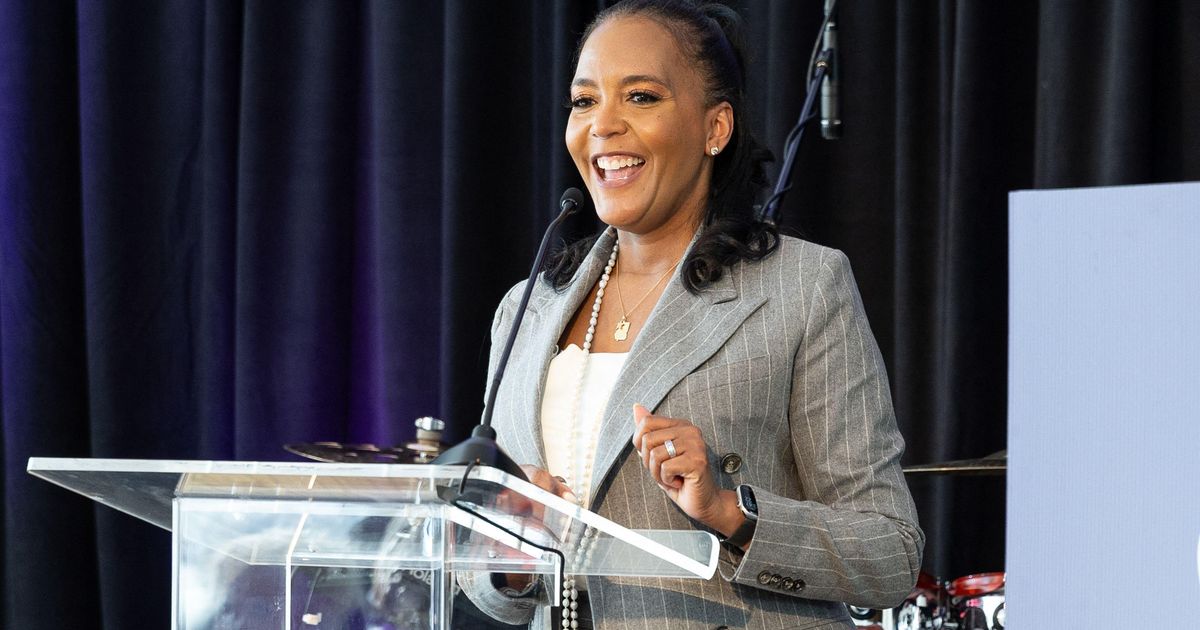

Keisha Lance Bottoms, quite possibly the next Governor of Georgia.
Photo: Lawrence Cooper/Sipa USA/Alamy Stock Photo
The political world is, understandably, focused on 2026 Senate and House races. The question of whether the Republican Party will maintain its trifecta control in Washington has enormous repercussions for the last two years of Donald Trump’s second term
But partisan control of state governments matters too, even at the federal level, as the ongoing battle of Republican and Democratic gerrymanders shows. There will be 36 gubernatorial elections in November, with each party defending 18 governorships. The overall partisan balance is currently close, with Republicans holding 26 governorships and Democrats 24. Each party has a clear and achievable goal. The GOP is trying to avoid the usual midterm pattern of losses by the party controlling the White House (which has happened in 16 of the last 20 midterms), while Democrats are seeking their first national majority of governorships since their catastrophic losses in 2010.
Since governors have their own agenda and they command media attention that most members of Congress can only envy, national partisan divisions aren’t strictly transferable to gubernatorial elections. But in this day and age, straight-ticket voting is still ascendant and partisanship matters, as Sabato’s Crystal Ball observes in looking at 2026 races:
Republicans hold 22 of the 25 governorships in states that voted for Donald Trump all three times he was on the ballot (the exceptions are Kansas, Kentucky, and North Carolina), while Democrats hold 17 of the 19 states that never voted for Trump (New Hampshire and Vermont are the exceptions).
Of the half-dozen states that backed presidential candidates from both parties in the last three elections, Democrats hold four (Arizona, Michigan, Pennsylvania, and Wisconsin) and Republicans hold two (Georgia and Nevada). So Democrats are competitive with Republicans in the overall count despite there being more red states than blue states because they are doing better in the swing presidential states and they are a little more extended into redder states than Republicans are extended into bluer states.
Among the red states with Democratic governors, two of them (Kentucky and North Carolina) are not holding gubernatorial elections in 2026. The current two-term governor of Kansas is Democrat Laura Kelly, who is term-limited, and who has benefited enormously from divisions in the GOP ranks. If Republicans can stay united, they will be favored to capture this governorship. Similarly, deep-blue Vermont’s very popular (and non-MAGA) Republican Governor Phil Scott hasn’t announced his plans for 2026. If he retires, Vermont will almost certainly elect a Democrat.
One big question in the more numerous purple states with competitive 2026 governor’s races is whether a national Democratic breeze will flip what Cook Political Report calls toss-ups in Arizona, Georgia, Michigan, Nevada, and Wisconsin. All five of these states were carried by Joe Biden in 2020 and by Donald Trump in 2024. Here’s a closer look at these crucial races.
Arizona is an intensely competitive state with a vibrant MAGA culture — sometime too vibrant, as Democrat Katie Hobbes’ 2022 win over Kari Lake illustrated. Now Hobbes is running for reelection, with decent but not overwhelming job approval numbers (53 percent approve, 35 percent disapprove, according to Morning Consult). The big development has been among her Republican challengers, with the very wealthy and arguably more electable Karrin Taylor Robson dropping out recently. That made former House Freedom Caucus chair Andy Biggs the GOP front-runner, though Congressman David Schweikert is also in the race. Handicappers had considered this contest a toss-up, but most have now re-rated it as leaning Democratic with the arch-reactionary Biggs the likely GOP nominee. The primary is on July 21, and there is no runoff requirement.
The superb politician Brian Kemp has held onto Georgia’s governorship for eight years despiteunfavorable shifts in the state’s political demography and Trump’s hostility toward him. (The president tried but failed to purge Kemp in 2022 after the governor joined Secretary of State Brad Raffensperger in certifying Joe Biden’s 2020 win in the state.) Kemp twice defeated Democratic rockstar Stacey Abrams. Now he’s term-limited, and the battle to succeed him has become a wild multi-candidate brawl. Among Republicans, Raffensperger and another 2020 non-election-denier, state attorney general Chris Cox, were facing Trump endorsee and state lieutenant governor Burt Jones in a relatively quiet race. Then a self-funding billionaire health care executive, Rick Jackson, jumped into the contest and began running abrasive ads aimed at both Jones (whom he called lazy and corrupt) and Raffensperger (ads simply call him “Judas”). Georgia, importantly, does require a majority vote to win party nominations, so in this crowded race a May 19 primary is all but certain to lead to a June 16 runoff. Right now Jackson (who is trying to get Trump to back off his exclusive Jones endorsement) and Jones are leading the polls, but Raffensperger and perhaps Carr still have a shot at a runoff spot.
Watching the Republicans somewhat from the shadows is a sizable Democratic field that formed even before Abrams declined a third gubernatorial run. The clear front-runner is former Atlanta Mayor Keisha Lance Bottoms, who is doing especially well among the large Black Democratic primary electorate. Hoping to make a runoff against Bottoms are former state lieutenant governor Geoff Duncan, a party-switcher who pivoted hard against Trump but is trying to live down past conservative policy positions; Black political pioneer Michael Thurmond, most recently CEO of the large Atlanta suburb DeKalb County; and state legislator Jason Esteves, an up-and-comer who is both Black and Latino. Going into the cycle Republicans were thought to have an advantage in this race, but between the name-calling and mud-throwing of GOP candidates and a midterm pro-Democratic breeze, that has changed.
What makes the race to succeed term-limited Democrat Gretchen Whitmer unusual is the independent candidacy of former Detroit mayor (and until recently a Democrat) Andrew Duggan. With a business background and a record associated with Detroit’s economic comeback, Duggan has significant labor backing and some appeal to voters in both (and beyond both) major parties. But you get the sense he’s drawing more from Democratic front-runner and Michigan Secretary of State Jocelyn Benson, who is campaigning as a center-left can-do pol in the mold of Whitmer. As a result, Republican front-runner John James (a two-term congressmen who built name ID and a strong identity as a Black conservative with two losing but credible Senate races in 2018 and 2020) is running slightly ahead overall in three-candidate polls. James is having to fight off several other Republican candidates, including 2024 presidential candidate Perry Johnson. Michigan’s primaries aren’t until August 4, and there is no majority-vote requirement. Duggan will probably either fade by November or become a seriously competitive candidate who could win.
Nevada could be an important barometer for 2026. Trump carried the state in 2026, and his signature “no tax on tips” initiative is especially popular here. There’s a reasonably popular incumbent Republican governor, Joe Lombardo, whose electoral base is in Democratic-leaning Las Vegas. But iffy economic prospects and a pervasive cost of living crisis in Nevada are creating a big Democratic opportunity in 2026. Early polls show Lombardo essentially tied with the Democratic front-runner, two-term Attorney General and former legislator Aaron Ford, the first Black politician to hold a statewide elected office in Nevada. Ford does have a significant primary challenger in Washoe County (Reno) Commission Chair Alexis Hill, who is running notably to the front-runner’s left. But Ford’s advantage in name ID, endorsements and fundraising is probably too much for any challenger to overcome before the June 9 primary.
In the general election Lombardo will be saddled with incumbency in a less-than-ideal election year and Ford must cope with negative publicity over out-of-state travel during his long tenure in public office. But it’s likely to be as close as the 2022 election when Lombardo edged then-incumbent Democratic Governor Steve Sisolak. Nevada is that kind of state.
Democrats have been on a recent upswing in the quintessential battleground state of Wisconsin, making gains against entrenched Republican majorities in the legislature and in the judiciary. But one key position they’ve held for eight years now, the governorship, is up for grabs in 2026 with incumbent Tony Evers choosing to retire. Republicans have quickly coalesced around the gubernatorial candidacy of House Freedom Caucus congressman Tom Tiffany, whom Trump endorsed in January. But Democrats have a huge field with no real favorite. The best known by far is former state lieutenant governor Mandela Barnes, who lost a 2022 Senate race to Ron Johnson that a lot of observers expected him to win. But with an August primary (there is no runoff requirement in Wisconsin), there’s plenty of time for other candidates to challenge him. One to watch is Mandela’s successor as state lieutenant governor Sara Rodriguez, a suburban Milwaukee politician who has made Medicaid expansion her signature issue. Another is David Crowley, who became Milwaukee County’s first Black Executive in 2020 at the age of 33. There are also two viable candidates from the progressive bastion of Madison. One is state senator and veteran abortion rights champion Keldra Roy. And another is state legislator and professional chef Francesca Hong, a self-identified socialist.
A February Marquette Law School poll of the Democratic gubernatorial field showed Hong with 11 percent, Barnes with 10 percent, and no one else out of single digits; 65 percent were undecided. A TIPP poll in March matching Tiffany against three Democrats showed him leading Hong by three percent but trailing Barnes by two percent and Rodriguez by three percent. So this race has a long way to go.
The gubernatorial races highlighted above aren’t the only potentially newsworthy contests, of course. Republicans are thought to have an solid advantage in Ohio, where Trump has won three times and Republicans have controlled the governorship since 2010. But likely GOP nominee and 2024 presidential candidate Vivek Ramaswamy is in a very close race with former State Health Director Amy Acton. Similarly in Iowa, where the bottom has fallen out for Democrats since 2014, state auditor Rob Sand, the only Democratic statewide elected official left, has a shot at the governorship thanks to the very unpopular performance of retiring incumbent Republican Kim Reynolds and a large GOP field to replace her. Perhaps the weirdest possibility in the whole country is in California, where a scattered ten-candidate field in the state’s non-partisan top two primary could in theory send two Republicans to the general election, locking out the Democrats who have an enormous majority in the electorate. So don’t get too fixated on congressional elections. There’s plenty of drama down-ballot.
