
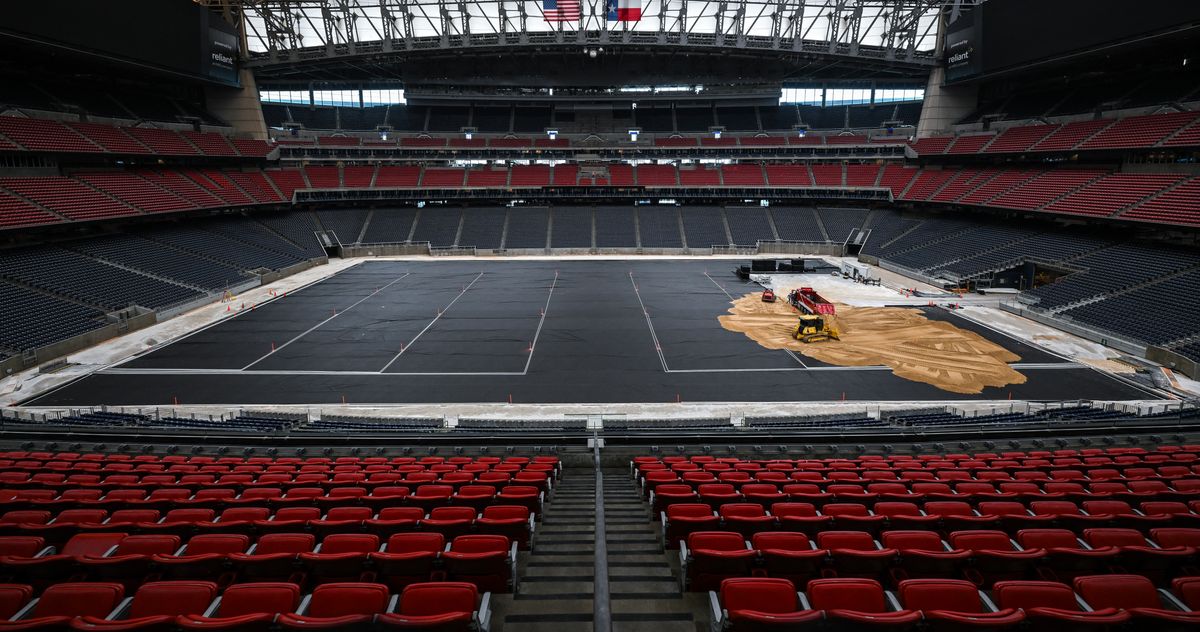

Workers prepare Houston Stadium (temporarily renamed from NRG Stadium) for the 2026 FIFA World Cup in Houston, Texas, on May 11, 2026.
Photo: Ronaldo Schemidt/AFP/Getty Images
It is rare that the current occupant of the White House says something that unifies every American. So I suppose it’s telling that the one time I can remember it happening has come at the expense of FIFA.
When a reporter asked President Trump last week what he thought of the fact that the minimum get-in price for the United States’s World Cup opener against Paraguay in Los Angeles on June 12 was $1,000 (currently $1,037), his response, for once, spoke for all of us. “I did not know that number,” Trump said. “I would certainly like to be there, but I wouldn’t pay it either, to be honest with you.”
I’m fairly certain Trump couldn’t name five soccer players — not without saying “I saw Pelé at Studio 54” five times. But on this point, he is not wrong.
With the World Cup now less than one month away — it opens June 11 with two games in Mexico City, and Canada and the United States host their first games the next day — the breakout story of the world’s most popular sporting event to this point is not ICE agents outside venues, whether Iran will be participating (still sort of up in the air, actually), or Heaven forbid, who will end up winning the thing. It is ticket prices.
There are projections that the World Cup Final on July 19 will be the most expensive sporting event in human history. (The get-in price is currently more than $9,000 with the average ticket about $13,000; one reseller is offering four seats for $2.2 million.) But every match is absurdly priced now. The cheapest price for any game — there will be 104 — is $162 with the average ticket price landing at about $1,600. The draconian FIFA tier-pricing structure is deceptive at best and outright fraud at worst. Even New Jersey Transit took a hit after reports came out that it was charging more than $150 round-trip for its train from NYC to the final in East Rutherford and back, a journey that usually costs about 13 bucks. NJ Transit eventually lowered the price to $105, which didn’t help its cause much.
FIFA president Gianni Infantino, last seen giving Trump the FIFA Peace Prize, claims these extortionary prices are a result of overwhelming demand and the United States’s lack of regulation in the ticket-resale market. (The games in Canada and Mexico have a cap on resale prices.) “We have to look at the market. We are in the market in which entertainment is the most developed in the world. So we have to apply market rates,” Infantino said. “In the U.S., it is permitted to resell tickets as well. So if you were to sell tickets at the price which is too low, these tickets will be resold at a much higher price.”
This is misleading at best. The World Cup resale market is controlled by FIFA, which is taking a reported 30 percent cut on all resale transactions. (And is apparently being slow to get those vendors their cash.) Essentially, FIFA and Infantino are artificially inflating the price of tickets on resale markets they own and then claiming the prices are high because of demand that does not seem to exist. The Athletic’s Henry Bushnell has done a terrific job tracking the market of World Cup ticket prices and has observed just how few tickets are even available for resale on these exchanges, a sign that FIFA is (as many have long expected) withholding tickets in order to create the illusion of scarcity. This is particularly true when it comes to United States games, which have been wildly overpriced and are selling shockingly slowly, another sign that FIFA is controlling the entire marketplace and very much overestimated Americans’ desire to watch their own players ahead of far more talented and better-known teams from around the world. FIFA is rigging the game.
But they were always going to. This is not only who FIFA is — here is your reminder that the past two World Cups were held in Russia and Qatar, decisions that were the result of rampant corruption — but it’s also the reason the World Cup is being hosted by the United States (and occasionally Mexico and Canada) for the first time since 1994: This is where the money is. The men’s World Cup is the biggest moneymaker for FIFA, which, amusingly, is ostensibly a nonprofit. The tournament funds everything it does, which means it will go all out for every possible dollar. This is not like the Super Bowl, the World Series, or the NBA Finals, all sporting events that happen every year, in the same country, involving the same league and the same people. FIFA is here to hoover up every penny it can and then head off to the next grift. (Spain, Morocco, and Portugal, it’s your turn in 2030.) Infantino can be as shameless as he wants; he’ll be out of here by August, after all.
So where does that leave fans who just want to see a World Cup match in what will likely be the tournament’s only visit to the U.S. for decades? Well, screwed, obviously, but there is some hope coming: FIFA can inflate the market and hold back tickets all it wants, but eventually, when these games finally happen, stadiums will need people physically in every seat. And it’s increasingly clear the prices FIFA is currently charging are just unrealistic. Bushnell reported last week that prices on resale markets are already beginning to drop, and there’s no reason to think that won’t continue. Currently, the cheapest seat to see, say, South Africa play Czechia at Mercedes-Benz Stadium in Atlanta, at noon on a Thursday, is $204. A premium seat is $2,500. Unless there is a massive contingent of South Africa and Czechia fans in the greater Atlanta area that I’m unaware of, those prices are listed, right now, to lure in suckers. If those prices don’t lower, that building will be half full.
That is not going to happen. FIFA can try to game the system however it wants, but eventually a market is going to resemble an actual market. Ticket prices won’t end up being bargains, necessarily. But the minimum price to watch the United States play in the World Cup — for you, for the president, for anybody else — won’t end up being $1,000. The World Cup is the biggest sporting event on the planet, but at the end of the day, it’s still just a sporting event.
