
(RNS) — I was in Miami a few weeks after Nicolás Maduro was forcibly removed from office by a U.S. military strike in December 2025. Miami’s Venezuelan community — many of whose members had fled persecution and repression — were openly celebrating in the streets. For them, the end of an authoritarian regime was personal, and in that moment relief and hope were equally palpable.
Yet for many watching from a distance, the manner of Maduro’s removal — swift, decisive and legally contested — carried a moral weight that celebration could not quite lift. There was gratitude for the possibility of freedom and, at the same time, a lingering unease about the means by which that freedom was secured. The outcome inspired hope. The method raised questions.
Two months later, the current military action against Iran produces the same unease. Few can defend the Iranian regime’s record of repression of dissent at home, its entanglements in regional violence and international terror abroad. Genuine peace and freedom for the Iranian people are things to work toward and to pray for.
But the speed, scale and unilateral force of the action have unsettled even those who long for change. Across my news feed, political leaders express variations of the same sentence: We opposed that regime for years, but we cannot support the way this was done. The tone is measured, serious, morally careful — as if each speaker senses the ground shifting beneath their feet.
It would be easy to dismiss such responses as partisan reflex. In a polarized age, nearly every action is measured by party loyalty for political advantage. But — there’s that small word again, pushing back on the idea that our objection to the attack on Iran is merely factional. Every time we talk about the ethics of this or that U.S. action, “but” sounds less like spin and more like strain; less like calculation and more like moral pressure building against the walls of justification.
It’s a sign of a kind of ethical dissonance, a tension that arises when the justifications we use appeal to different systems of moral reasoning. Public life in the United States is animated by more than one moral grammar. One frame asks: Will this action produce greater security? Will it prevent future harm? Another asks: Was it authorized? Was it lawful? And still another asks: What kind of people are we becoming as we act in this way?

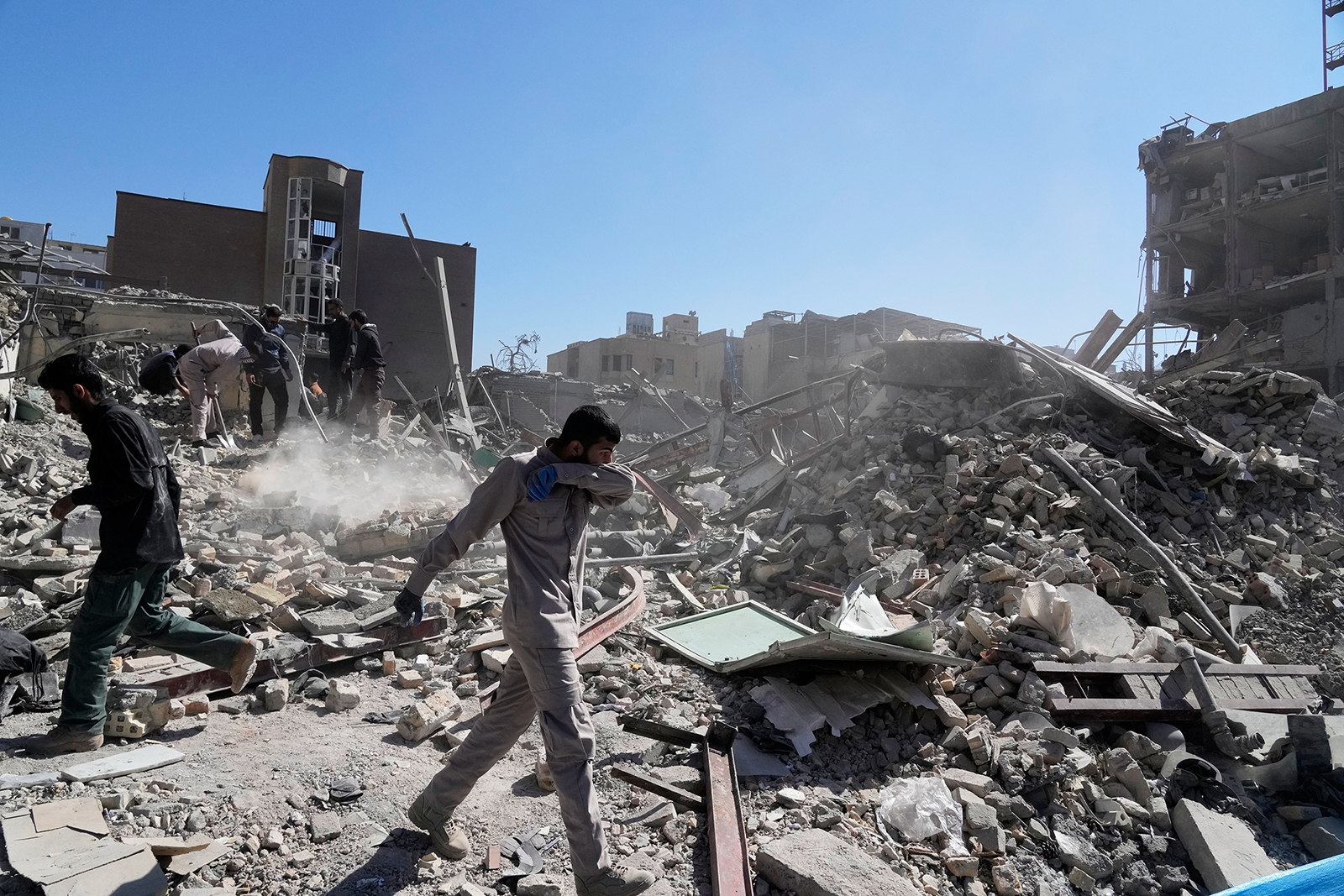
People watch as smoke rises on the skyline after an explosion in Tehran, Iran, Saturday, Feb. 28, 2026. (AP Photo)
The divergent answers we arrive at reflect not merely competing conclusions but competing moral logic. The ends we desire and the means we employ both seem defensible, but the frameworks that authorize them don’t sit comfortably together. Something in us senses the strain.
Christians should not be surprised by this tension. Our own Scriptures are marked by it. The Bible contains stories of liberation and mercy, stories in which divine judgment is enacted through violence and defeat. The God who hears the cry of slaves in Egypt also acts decisively against Pharaoh’s army at the Red Sea. How are we to read such texts? How do we hold together the mercy we proclaim in worship with the forceful power depicted in these narratives?
From its earliest centuries, the church wrestled with this question. It rejected the impulse, found among the followers of the early church theologian Marcion, to sever the “vengeful” God of Israel from the God revealed in Christ. But neither did it assume that every invocation of God in Scripture or history exhausts the fullness of the divine character. The path the church has taken, for most of its history, is to read these tensions through a hermeneutic shaped by the person, work and teaching of Christ.
Thinking about the ethical dissonance these events stir in me, I find myself returning to Jesus in the wilderness, a story that we hear in this season of Lent. There, Satan offers him power without suffering, authority without obedience, kingdoms without the cross. The temptation is plausible: One can imagine good being accomplished by seizing control, harm prevented by force.
The issue, however, is not whether good ends matter, but how those ends are authorized. Jesus, in the desert, refuses. He refuses not because suffering is insignificant, or power irrelevant, but because the way he will rule reveals the nature of the kingdom. That refusal reframes the difficult texts of Scripture. It suggests that not every claim made in God’s name — in ancient narratives or in contemporary politics — reflects the fullness of God’s character. It invites humility about our own moral certainty.
We cannot expect nations — or ourselves — to inhabit perfectly consistent ethical systems. The world’s brokenness often elicits broken responses. Decisions are made under pressure. Consequences matter. Law matters. Security matters. Yet even when we persuade ourselves that an action is necessary, something in us may hesitate. Perhaps that hesitation is less moral indecision than conscience resisting our rush to certainty.
The Christian tradition has a name for the gap between what we profess and what we enact. It’s called sin. Not because every action in public life is reducible to evil, but because our motives are rarely unmixed. Fear blends with prudence. Pride disguises itself as resolve. Self-preservation can masquerade as righteousness.
Lent does not simplify the moral landscape. It does not promise clean hands in a fractured world. What it offers is grace for those willing to look honestly at their own hearts. Lent trains that honesty. It invites us into a kind of theological realism — a refusal to deny the world’s brokenness or our participation in it. It asks us to sit with moral tension rather than resolve it too quickly in our own favor.
We may never inhabit perfectly coherent moral frameworks. But we can refuse the comfort of calling our violence necessary and our motives pure. Perhaps that refusal — that steady, unsentimental clarity about ourselves — is the beginning of wisdom.
(The Rev. Michael W. DeLashmutt is dean of the Chapel of the Good Shepherd and senior vice president at the General Theological Seminary in New York City, where he also serves as associate professor of theology. His most recent book is “A Lived Theology of Everyday Life.” The views expressed in this commentary do not necessarily reflect those of Religion News Service.)
