
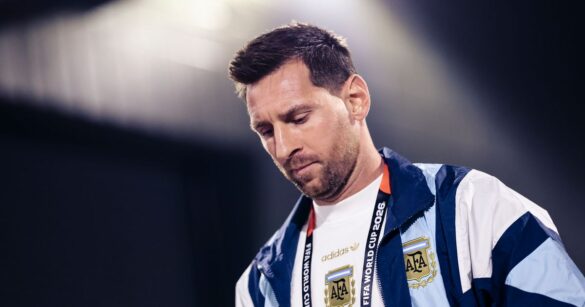

Photo: Maja Hitij/FIFA/Getty Images
Lionel Messi, by most estimates the greatest soccer player ever, celebrated his 39th birthday a little early this week at a World Cup that already has his name all over it. He did so in typical Messi fashion: with a series of improbable, elegant goals and a new record. Messi has now been at the top of the world’s most popular sport for nearly 22 years. He’s won a World Cup, four Champions Leagues, 13 league titles, eight Ballon d’Ors — more than anyone ever — and now the most World Cup goals of all time (18), among dozens of other honors. So far at this World Cup, he’s scored a ridiculous five goals in two games. That’s already a lot of Messi, no matter how you look at it.
And yet we — you, me, most living soccer fans, or just casual observers — want more from him. We expect more from him. Hype aside (of which there is plenty), there is never enough Messi for us. Eventually we tire of indulging in the best of anything, whether it’s Tom Brady or prestige television; overexposure accumulates and haters proliferate. Yet apart from a small legion of unserious internet trolls, Messi is largely haterproof, even to fans of teams he has obliterated over the years. What is it about him? What makes this five-foot-seven, unassuming guy with limitless talent so unique? It’s actually hard to say.
There is his inimitable style of play, of course. This was exemplified by his most recent goals, both against Austria on Monday. Messi is a guy who can write his own scripts, and fittingly, each goal exemplified the two phases of his career. The first was a typical late-career lurker, starting with an outlet pass from him in midfield. Play moved to the wing, while Messi strolled quietly behind in the center. It was a trap; the ball was crossed into the middle, his teammate in front let it pass, and from 17 yards or so, Messi came sneaking in late — unnoticed, somehow — to calmly blast it with precision low into the corner of the goal.
For his second, he turned back the clock to the 2000s, when he earned the nickname “La Pulga Atomica” (“The Atomic Flea”) from Spanish media. Though Messi doesn’t run a lot anymore, in the game’s 94th minute, he galloped along the sideline with the ball, sensing opportunity. He found his teammate Julián Alvarez running toward goal with a slide-rule pass. Alvarez’s shot was blocked, but another teammate passed the ball to Messi, who was now in the box. That pass was deflected, only for Messi to coolly adjust by sticking his leg straight behind him, somehow trapping the ball perfectly — a classic example of Messi bending the laws of physics, or at least the limits of human ability, to his will. Then muscle memory set in and he dribbled into the box, building tension as he buzzed around the goal. He shot, was blocked again, then collected the rebound and — finally — put it in. After all these years, he still makes the impossible look inevitable.
Still, great goals are scored every World Cup and every single week throughout the soccer world. It’s not just his ability or aesthetics — there’s more to it. But what, exactly?
I asked Roger Bennett, founder of Men in Blazers Media Network, who has his finger on the pulse of soccer like few others, for help. If anyone can put the Messi mystique into words, it’s him.
“When we watch Lionel Messi, we are watching an everyman perform acts of human transcendence over and over, and across decades,” Bennett told me. “The man looks like he has just walked out of your local Supercuts, but he has an ability to place himself into the future, to know where to move to hurt his opponents and where the ball is not but will soon be.”
It’s true. Some of Messi’s contemporaries in his generation and the one after are hyperathletic physical freaks and as much as 14 years younger than him. Yet they still don’t have what Messi has — and they know it. Several are off to fast starts this World Cup, including Kylian Mbappé of France, Erling Haaland of Norway, and Harry Kane of England. Asked who of that group was the best, Mbappé, coming off his second two-goal game, said, “Lionel Messi, it’s clear.” (Consider here that Mbappé and Messi are former club teammates who didn’t always see eye to eye and that Argentina’s fans and even players have long hurled gross and racist insults at Mbappé.)
Mbappé went on to mention Cristiano Ronaldo — tall, handsome and self-centered, Messi’s contemporary foil in every way. Their rivalry is an endless topic of partisan, puerile discussion. Countless words have been written about their duality, how Ronaldo stripped his game to become a pure goal-scoring machine, the optimized soccer player in pursuit of bigger numbers, more trophies, and cold statistics, to great success. But while honors are always at the forefront with Ronaldo, the thing with Messi is that, aside from the World Cup win in 2022 that had previously eluded him, his many championships, awards, and plaudits often seem like an afterthought.
To go a step further, Messi is more than the sum of his goals or his awards. For that, he’s worshipped, even in America — especially in America. During Messi’s first season stateside in 2023, at Inter Miami, his on-field bodyguard (an MMA fighter who’s become famous himself) claimed more fans rushed the field in Messi’s first 20 months in America than in his previous seven years in Europe. You can debate whether Americans know soccer, but it’s inarguable we know when a superstar nonpareil is among us. American interest has steadily transformed the game — treating soccer, and sports, as entertainment doesn’t come naturally to the rest of the world like it does to us — and so with Messi’s increased visibility to Americans, the perception of him and the essence of his greatness has been supercharged.
What do these people want, exactly, when they mob him? It’s certainly not a conversation. Messi is a supernova on the field but a bore off it. Much has also been written over the years about him giving little of himself, or perhaps having little to give. Athletes are often uninteresting people, especially in interviews, but Messi seems to stand alone in this realm as well. The British writer John Carlin has interviewed Messi twice and said he wouldn’t do it again if given the chance. In 2018, Sam Borden, assigned to write 4,000 words on Messi for ESPN’s erstwhile magazine, was granted about eight minutes of sharing a room with the player during a photo shoot and, from the sounds of it, about five seconds of face time. The most Messi could give him (for what Borden deftly turned into a “Frank Sinatra Has a Cold”–style profile on the star’s reticence) was a quick handshake and a few bland email responses. On a recent Pablo Torre Finds Out podcast, the writer Daniel Alarcón described an even worse encounter in which Messi’s handlers made him wait for eight hours in a room before he was finally allowed to interview the star at his most evasive and uninterested.
Perhaps Messi still captivates the imagination because, in an age of celebrity overexposure, he remains an enigma, like Shohei Ohtani. Or maybe it’s because there’s nothing to expose. Messi’s not even interested in flashing his fancy cars and toys, unlike Ronaldo, a six-foot-two, 41-year-old megastar with an unabated Napoleon complex. Nor does he seem interested in using his influence to end wars, hunger, or poverty. Messi also never engages in English, despite living in Miami for years. What does Messi actually like besides soccer? Who knows. Most of what we see are the things he’s paid to like: Pepsi, Michelob Ultra, Adidas, Duracell batteries … and Saudi Arabia, from which he controversially earned $25 million as a “tourism ambassador.” A half-baked theory of mine is that we subconsciously register that he’s too low-key, too boring, too soccer-brained to actually indulge in any of this stuff — that all the endorsements are simply de rigueur for an athlete in his stratosphere. And so it follows that these nakedly commercial, obviously transactional appearances only add to his soccer-genius aura.
His lack of introspection is even contagious; those around Messi seem unable to verbalize his greatness. Over the years, his teammates and coaches often revert to some version of “What can you say about a guy like him?” On Monday, his Argentina coach, Lionel Scaloni, said, “I have no words to talk about Leo; it all makes us a bit tired,” before going on vaguely about his commitment and its effect on others.
Which is to say that Messi, maybe more than any other, has the je ne sais quoi. But even this isn’t quite accurate. The phrase is actually a contemporary translation of the original phrase by Pliny the Elder in ancient Rome. His Latin version is inane nescio quid; Pliny used it to describe that invisible, mysterious attraction of magnets, and that right there seems like the most apt description of Messi’s effect on most of us.
It’s true that there are some small corners of the soccer world experiencing Messi fatigue. Once again, Americans are ahead of the curve here. When Messi came to Miami in 2023, Major League Soccer enticed him with an offer nobody could refuse: In addition to a generous salary, it included a share of the league’s $2.5 billion TV deal with Apple and a cut of jersey sales of all teams (not just Messi jerseys). MLS was obviously interested in earning a return on its investment, and observers have complained that the league has fashioned itself into Messi’s league, in image and in competition. Then there’s Fox Sports, which has been hyping up Messi early and often this World Cup. It’s to be expected — not doing so would be foolish, of course. Amid all this, some American soccer media figures have privately complained to me about an onset of Messi sickness.
While understandable, that attitude strikes me as shortsighted. “Messi’s final World Cup” has become something of a running joke over the years, although surely this is it; he was on the fence about playing in this one, and who knows how long he’ll last in Major League Soccer. This summer is the last chance for the entire world to simultaneously witness new moments of his on the biggest stage. The true aura of Messi is that when he plays, there is a feeling of momentousness — like Bennett said, of transcendence that other players simply don’t have. Everyone, even the youngest of us, can feel it. For such a standoffish figure, his otherworldly abilities unite us all, again and again. That’s the real reason we can’t turn away.
“It is the memories we make collectively watching Messi that attest to his true greatness,” Bennett explained. “The knowledge that we are all watching a human perform feats in the present that will be talked about for centuries to come, like Mozart or Shakespeare.”
Soccer is the ultimate spectator sport, best enjoyed with others — as in the entire world right now. And Messi’s talent is, put most simply, timeless. No matter how much he gives, no matter how many more moments of wonder he provides on his aging, high-mileage legs, he invariably observes the first rule of entertainment: always leaving the crowd wanting more.
