
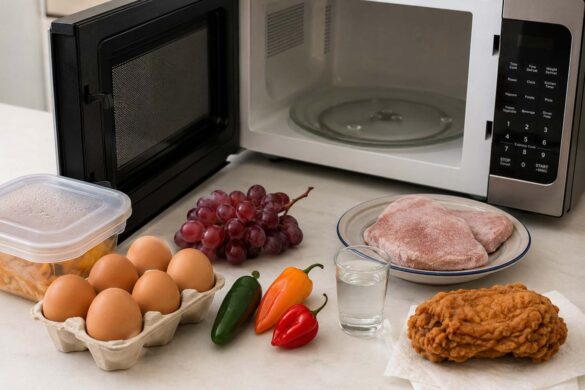
The microwave is the most used and least understood appliance in most kitchens. It has been a household staple for 50 years, and yet most people have never thought carefully about what actually should not go in one. Some foods create genuine safety hazards: explosions, fires, toxic fumes, dangerous hot spots in food that looks heated through. Others are simply ruined in ways that are permanent and entirely avoidable. A few surprises are on both lists.
What foods should you never microwave?
The short answer: Eggs in the shell, grapes, hot peppers, high-proof alcohol, non-microwave-safe plastics, frozen meat you are not cooking immediately, stuffed poultry, and fried foods should never go in the microwave. Some create fire or explosion hazards. Others create food safety risks through uneven heating. Others are simply destroyed by the process in ways that cannot be undone.
For how to store these foods correctly before cooking, see our Food Storage Guide.
📋 Foods You Should Never Microwave: At a Glance
| 🥚 Eggs in the shell | 🍇 Grapes |
| 🌶️ Whole hot peppers | 🍶 High-proof alcohol |
| 🧊 Frozen meat (not cooking immediately) | 🍗 Stuffed poultry |
| 🛢️ Non-microwave-safe plastics | 🍟 Fried foods |
| 🫐 Small whole fruits (cherry tomatoes, blueberries) | 🦪 Shellfish in the shell |
| 🥕 Carrots and certain root vegetables | 🍼 Breast milk and formula |
🔑 Key Takeaways
- Eggs in the shell can explode in the microwave, mid-cooking or after removal. The explosion can cause serious burns, including if the egg erupts in your hand or mouth after heating.
- Grapes create plasma when microwaved, a burst of superheated ionized gas that can damage the interior of your microwave and cause fires. The 2019 Nature paper that explained this mechanism confirmed it destroys microwaves.
- Microwaving whole hot peppers vaporizes capsaicin, the compound responsible for heat. The invisible cloud released when you open the door can cause severe eye irritation, coughing, and throat burning.
- High-proof alcohol releases flammable vapor in a sealed microwave cavity. A stray spark can ignite it.
- Microwaves penetrate food to a depth of only 1 to 1.5 inches, according to USDA FSIS. This means dense or stuffed foods have cold spots where bacteria survive reheating even when the surface reads 165 degrees Fahrenheit.
- Non-microwave-safe plastics can leach chemicals including BPA into food when heated. Use glass or ceramic instead.
Why Microwaves Behave the Way They Do
Understanding a few basics makes the list below make sense. Microwaves work by emitting electromagnetic radiation that excites water, sugar, and fat molecules in food, generating heat through that molecular friction. They do not heat food from the outside in the way an oven does. They penetrate to a depth of about 1 to 1.5 inches, per USDA FSIS, with the rest of the food heating by conduction from that zone outward. This creates two problems that come up repeatedly on this list.
🔬 The Two Core Problems
The first is steam entrapment. Foods with sealed exteriors (shells, skins, sealed packaging) trap the steam produced by internal water molecules as they heat. With nowhere to go, pressure builds until the food ruptures. This is why eggs explode, whole fruits burst, and shellfish in shells are dangerous. The second is uneven heating. Dense or irregularly shaped foods develop hot spots and cold spots. The surface may reach a safe temperature while the interior remains in the bacterial danger zone. This is the specific risk the USDA warns about with frozen meat thawed in a microwave and not immediately cooked, and with stuffed poultry.
Foods You Should Never Microwave
1. Eggs in the Shell
Whole eggs in their shells should never go in the microwave, whether raw or hard-boiled. Raw eggs build steam rapidly as the water inside heats, and the shell cannot vent pressure fast enough. The result is an explosion that coats the interior of your microwave with egg and, if the egg is removed before it explodes, can erupt in your hand or on your plate. Hard-boiled eggs present the same risk for a different reason: even after cooking, residual moisture inside the yolk can superheat and turn to steam when the egg is reheated. The American Egg Board warns that hard-cooked eggs should not be microwaved in the shell.
⚠️ The Mouth Explosion Risk
Multiple food safety sources document cases of hard-boiled eggs appearing to reheat normally in the microwave but then exploding when bitten into. The superheated steam inside the yolk releases instantly when the outer surface is punctured. This can cause serious burns inside the mouth and throat. Always slice or chop boiled eggs before any microwave reheating.
Safe alternative: Reheat sliced or chopped cooked eggs in a covered pan over low heat. For a dish that uses cooked eggs beautifully the next day without reheating risk, our crustless veggie quiche and Greek meze board both work well served at room temperature. For full egg storage guidance, see do eggs go bad.
2. Grapes
Microwaving grapes is one of the most well-documented microwave hazards in food science, and the mechanism was only fully explained in 2019 when researchers published findings in the journal PNAS (Proceedings of the National Academy of Sciences). When a grape (or a grape cut in half with the halves touching) is microwaved, the electromagnetic fields become concentrated between the two sections due to the grape’s size, water content, and the way its skin focuses microwave energy. The result is a plasma fireball: a burst of superheated ionized gas that produces visible sparks, intense heat, and a realistic risk of damaging the microwave interior or starting a fire. The researchers who documented this went through 12 microwaves in the process.
The same phenomenon can occur with other small, high-moisture spherical foods: cherry tomatoes, blueberries, and quail eggs all have similar geometry and water content.
Safe alternative: If you want to use grapes in a warm application, roast them in a 400 degree oven for 15 to 20 minutes. The controlled heat produces a jammy, concentrated result with none of the plasma risk. For fresh grape storage guidance, see our post on how to store berries.
3. Whole Hot Peppers
Microwaving whole hot peppers releases capsaicin, the compound responsible for the burning sensation of spicy food, into the air as a vapor. Capsaicin vaporizes at the temperatures reached inside a microwave, and the vapor becomes trapped in the microwave cavity. When you open the door, the cloud releases directly toward your face. The effects are similar to exposure to pepper spray: intense eye irritation, coughing, and throat burning that can last for hours. This is not a minor inconvenience. It is a genuine hazard that multiple food safety experts and poison control resources document.
⚠️ Ventilation Is Not Enough
Opening a window does not adequately protect against capsaicin vapor released from a microwave. The concentration released when you open the door is immediate and direct. If you must reheat a dish containing whole chili peppers, use the stovetop with a lid and ventilation, or a conventional oven. Remove whole peppers before microwaving if possible. This applies to jalapeños, serranos, habaneros, and any other whole chili variety.
Safe alternative: Reheat pepper-containing dishes on the stovetop over low heat, covered. Our strawberry jalapeno salsa and chorizo stuffed jalapenos are both best served fresh rather than reheated.
4. High-Proof Alcohol
Heating high-proof alcohol in a microwave releases flammable vapor into the enclosed cavity. Microwaves can produce arcing (internal sparking) under certain conditions, and that spark in a vapor-filled enclosed space creates a fire risk. This applies to spirits, fortified wines, and any cocktail with significant alcohol content. The risk is proportional to proof: a beer or low-alcohol wine is unlikely to reach flammable vapor concentrations in typical reheating scenarios, but spirits and high-ABV cocktails are a different matter.
Safe alternative: Warm alcoholic drinks gently on the stovetop in a saucepan over the lowest heat setting, never above a simmer. This gives you control over temperature and eliminates the enclosed-cavity vapor risk.
5. Frozen Meat (If Not Cooking Immediately)
The USDA Food Safety and Inspection Service explicitly warns that meat thawed in a microwave must be cooked immediately afterward. This is not a quality guideline. It is a food safety rule. When frozen meat is thawed in a microwave, the outer layers begin to warm and may reach temperatures in the bacterial danger zone (40 to 140 degrees Fahrenheit) while the interior is still partially frozen. If that meat then sits at room temperature, even briefly, bacteria in the warmed zones multiply rapidly. The interior eventually reaches thawing temperature too, but by then the outer layers may already have dangerous bacterial counts.
⚠️ The USDA Rule
Microwave-thawed meat must go directly from the microwave into a hot pan or oven. No resting, no prepping other ingredients first, no setting it aside while you chop vegetables. The USDA is unambiguous: foods thawed in the microwave must be cooked immediately. For safe thawing that does not carry this risk, thaw frozen meat in the refrigerator overnight, or use the cold-water method (sealed bag submerged in cold water, changed every 30 minutes).
6. Stuffed Poultry
The USDA specifically warns against cooking or reheating stuffed poultry in the microwave. Microwave energy penetrates to about 1 to 1.5 inches, which means the center of a stuffed bird, the densest part of an already dense food, may never reach a safe temperature even when the surface reads correctly. The stuffing insulates the interior cavity from heat, the bones further disrupt even heating, and the result is a dish where the outside is hot and the center may still harbor Salmonella and other pathogens at temperatures that allow them to survive. This applies to whole roasted poultry being reheated as much as to raw stuffed poultry being cooked.
Safe alternative: Reheat leftover turkey or chicken with stuffing in a conventional oven at 325 degrees Fahrenheit, covered with foil, until a thermometer inserted into the center of the stuffing reads 165 degrees Fahrenheit. For leftover turkey and chicken storage guidance, see our how long do leftovers last guide.
7. Non-Microwave-Safe Plastics
Not all plastic is microwave-safe, and the distinction matters. Plastics that are not rated for microwave use can soften, warp, or melt at microwave temperatures, leaching chemicals including BPA (bisphenol A) and phthalates into food. The FDA has linked BPA exposure to concerns about hormonal disruption. Yogurt containers, takeout tubs, margarine containers, and single-use plastic bags are common examples of plastics that are not rated for microwave use.
✅ How to Tell If Plastic Is Microwave-Safe
Look for the microwave-safe symbol (a microwave icon or wavy lines) on the bottom of the container. If it is not there, do not use it in the microwave. Glass and ceramic containers are always the safest choice for microwave reheating. Never microwave plastic wrap directly touching food. If covering food with plastic wrap in the microwave, leave a gap so steam can escape and the wrap does not contact the food surface.
8. Breast Milk and Formula
The FDA explicitly warns against microwaving breast milk or baby formula. Microwaves heat liquids unevenly, creating hot spots within a bottle that may not be detectable from the outside. The bottle can feel warm or even cool to the touch while containing pockets of liquid hot enough to burn a baby’s mouth and throat. This risk is well-documented and the recommendation is universal among pediatric and food safety authorities.
Safe alternative: Place the sealed bottle or bag in a bowl of warm water for a few minutes, or run warm tap water over the bottle while rotating it. Both methods heat more evenly and safely. Shake or swirl the bottle and test a few drops on your wrist before feeding.
9. Shellfish in the Shell
Shellfish in their shells are a steam entrapment hazard in the microwave. Clams, mussels, and oysters in the shell build pressure as their internal liquid heats, and the shells can burst with significant force, sending shell fragments and hot liquid across the microwave interior. Even shellfish that do not burst often come out rubbery and overcooked due to their high collagen content and the rapid, uneven heat of microwave cooking.
See also

Safe alternative: Steam shellfish on the stovetop in a covered pot with a small amount of water or wine. They open naturally and cook evenly in 5 to 7 minutes. For a dish that showcases shellfish properly, our clam corn chowder is best made fresh and reheated gently on the stovetop.
10. Carrots and Certain Root Vegetables
Carrots can cause arcing in the microwave, which means producing visible sparks. This happens because carrots (and occasionally other root vegetables like beets and green beans) absorb minerals from the soil during growth. These minerals, particularly iron, magnesium, and selenium, can interact with microwave energy and produce sparks similar to what happens when metal goes in a microwave. The sparks can damage the microwave interior and, in a worst case, ignite a fire.
The arcing risk is most associated with dense, intact pieces. Thinly sliced or diced carrots in a dish with significant liquid (soup, stew) are much less likely to arc than large chunks heated on their own. If you notice sparking with any vegetable, turn the microwave off immediately and remove the food. Do not use a microwave that has been damaged by arcing until the interior has been inspected. For our carrot ginger dressing, carrots are used raw and need no heating at all.
11. Fried Foods
Fried foods exist for their contrast: crisp exterior, tender interior. The microwave destroys that contrast permanently. Steam produced during microwave reheating saturates the breading or batter from the inside out, producing a soggy coating that cannot be restored by any amount of additional time in the microwave. The more microwave time you add trying to crisp it up, the drier and tougher the interior becomes while the exterior stays soft.
✅ The Better Method
Reheat fried foods in a dry skillet over medium heat (2 to 3 minutes per side), a 400 degree oven on a wire rack (8 to 10 minutes), or an air fryer (3 to 5 minutes at 375 degrees). Any of these methods drives off surface moisture and restores at least some of the original crunch. The microwave cannot do this.
12. Processed Meats
Hot dogs, bacon, sausage, and similar processed meats present a specific microwave concern: the high fat and salt content creates uneven energy absorption, producing spots that reach very high temperatures while adjacent areas remain cold. This uneven heating creates the same food safety risk as with any protein: bacteria surviving in cold zones while the surface appears fully cooked. Hot dogs in particular can arc (spark) in the microwave due to the uneven distribution of salts and additives in the casing. If you see sparking, turn the microwave off immediately. Processed meats are better cooked on a stovetop or under a broiler where heat distribution is more controllable.
13. Whole Fruits With Intact Skin
Any small whole fruit with a tight, moisture-retaining skin can create a steam entrapment problem in the microwave. Cherry tomatoes, blueberries, and small plums are the most common examples beyond grapes. The skin prevents steam from escaping, pressure builds, and the fruit bursts. The resulting explosion can be surprisingly forceful and spreads scalding liquid across the microwave. Pierce or slice any whole fruit before microwaving if you need to heat it.
14. Tomato Sauce (Uncovered)
Tomato sauce will not create a safety hazard in the microwave, but it will create a mess that represents a significant quality issue. The thick consistency of tomato sauce traps steam until it bursts through the surface in a splatter pattern that coats the entire microwave interior. Each bubble that forms under the surface releases with more force than you expect. Beyond the mess, tomato sauce scorches in microwaves in a way it does not on the stovetop because the direct contact with the container bottom overheats the sauce before it distributes heat evenly.
Safe alternative: Reheat tomato sauce in a saucepan on the stovetop over low to medium heat, stirring occasionally. If you must use the microwave, cover tightly with a vented lid or plastic wrap that does not touch the sauce, and use medium power in short bursts, stirring between each. See our tortilla soup and strawberry jalapeno salsa for tomato-based dishes that reheat best on the stovetop.
15. Water (In Certain Conditions)
Plain water can superheat in a very clean microwave container with no nucleation points (scratches, impurities, or residue). Superheated water reaches above boiling temperature without actually boiling because there are no points for bubbles to form. When the container is then disturbed (picked up, stirred, or a spoon dropped in), the water erupts violently, sending boiling water outward. This is a documented phenomenon with confirmed burns, though it requires specific conditions (very smooth container, pure water, prolonged heating) that are not common in everyday use. The risk is real enough that the FDA has issued guidance about it.
✅ How to Prevent It
Place a wooden chopstick, a non-metallic stirrer, or a wooden skewer in the water before microwaving. These provide nucleation points that allow bubbles to form normally. Or simply heat water in a kettle rather than a microwave for any application where you need boiling water reliably and safely.
16. Metal and Aluminum Foil
Metal should never go in a microwave. This includes aluminum foil, metal twist ties, gold or silver-rimmed plates and bowls, stainless steel travel mugs, and any container with metal handles or decorative metal edges. When metal is exposed to microwave radiation, it reflects rather than absorbs the energy, causing the reflected waves to build up and produce arcing, the same visible sparking that happens with mineral-rich carrots. With metal, the arcing is more intense, more sustained, and more likely to damage the microwave interior, start a fire, or cause the magnetron (the component that generates microwave energy) to fail.
⚠️ The Twist Tie Risk
Small metal objects are often more dangerous than large ones in a microwave because their small size creates sharper concentration of reflected energy. A single metal twist tie from a bread bag can produce enough arcing to char the interior of your microwave in seconds. Always check containers and bags for any metal element before microwaving. This includes takeout containers with metal handles, Chinese food containers with metal wire handles, and any bag sealed with a metal-core tie.
Safe alternatives: Use microwave-safe glass or ceramic containers. If you need to cover food, use a microwave-safe lid, a paper towel, or microwave-safe plastic wrap held away from the food surface.
Foods People Think Cannot Be Microwaved But Can
| Food | The Myth | The Reality |
|---|---|---|
| Bread | Makes it dangerous | Safe but goes stale and rubbery quickly. 10 to 15 seconds only. |
| Raw potatoes | Will explode | Safe if pierced first. Always pierce with a fork before microwaving. |
| Scrambled eggs | Will explode like shell eggs | Safe when beaten first. The shell is the hazard, not the egg itself. |
| Fish fillets | Unsafe or smelly | Safe to microwave. Smelly if overcooked. Use medium power and short bursts. |
| Leftovers with meat | Always unsafe | Safe if stirred midway and verified at 165°F throughout with a thermometer. |
Frequently Asked Questions
Eggs in the shell explode in the microwave because the shell cannot vent the steam produced when the internal liquid heats rapidly. Pressure builds until the shell fails. Hard-boiled eggs can also explode when reheated because residual moisture in the yolk superheats and vaporizes when the egg is bitten or cut. Always remove eggs from the shell and slice or chop them before any microwave reheating. For full egg storage guidance, see do eggs go bad.
Why do grapes spark in the microwave?
Grapes create plasma in the microwave because of their size, spherical shape, and water content. Microwave energy becomes concentrated at the point where two grape halves touch, creating electromagnetic hotspots that ionize the surrounding air into plasma, producing visible sparks. This was documented in a 2019 paper published in PNAS (Proceedings of the National Academy of Sciences). The same phenomenon can occur with other small, high-moisture, spherical foods including cherry tomatoes and blueberries.
Is it safe to microwave plastic containers?
Only if they are labeled microwave-safe. Plastics without that label can soften, warp, or leach chemicals including BPA into food when heated. Yogurt tubs, takeout containers, margarine tubs, and single-use plastic bags are all common examples of non-microwave-safe plastics. Glass and ceramic are always the safest choices for microwave reheating.
Can you microwave hot peppers?
Whole hot peppers should not be microwaved. Heating releases capsaicin vapor that becomes trapped in the microwave cavity and releases toward your face when you open the door. The effect is similar to pepper spray: intense eye irritation, coughing, and throat burning. If you must reheat a dish that contains chili peppers, remove the whole peppers first or reheat on the stovetop with ventilation.
Can you reheat fried chicken in the microwave?
You can, but the result will be disappointing. Microwave steam saturates the breading from the inside, making it permanently soggy. No amount of additional microwave time restores the crust. For crispy reheated fried chicken, use a dry skillet over medium heat, a wire rack in a 400 degree oven, or an air fryer at 375 degrees. All three methods drive off surface moisture instead of adding it.
Why does the microwave heat food unevenly?
Microwaves penetrate food to a depth of only 1 to 1.5 inches, according to USDA FSIS. Beyond that, heat must travel inward by conduction, just as in a conventional oven, but much more slowly because microwave cooking times are short. Dense foods, thick cuts, and foods with uneven geometry all develop hot spots at the surface and cold spots at the center. Stirring midway through reheating, rotating the container, and using medium power rather than full power all reduce but do not eliminate this uneven heating.
Is it safe to microwave frozen meat?
Only if you cook it immediately afterward. The USDA Food Safety and Inspection Service states that meat thawed in a microwave must be cooked immediately because the outer layers enter the bacterial danger zone (40 to 140 degrees Fahrenheit) during thawing. If you walk away and let microwave-thawed meat sit before cooking, the warmed outer layers become a bacterial growth environment. For safe thawing without time pressure, use the refrigerator overnight or the cold-water method.
Can you microwave breast milk?
No. The FDA advises against microwaving breast milk or formula. Microwaves heat liquids unevenly, creating hot spots within the bottle that can burn a baby’s mouth and throat even when the bottle feels warm on the outside. Warm breast milk and formula by placing the sealed bottle in a bowl of warm water for a few minutes, or run warm tap water over the bottle while rotating it.
Why do carrots spark in the microwave?
Carrots absorb minerals from the soil including iron, magnesium, and selenium. These minerals interact with microwave energy and can produce arcing, the same sparking phenomenon that happens when metal goes in the microwave. If you see sparks while microwaving carrots or other root vegetables, turn the microwave off immediately and remove the food. Thin slices in a liquid-based dish are much less likely to arc than large intact pieces.
Can you microwave alcohol?
You should not microwave high-proof alcohol. Heating spirits and high-ABV cocktails in a microwave releases flammable vapor into the enclosed cavity. Microwaves can produce stray sparks under certain conditions, and ignition in a vapor-filled cavity is a real risk. Warm alcoholic drinks gently on the stovetop in a saucepan over low heat instead.
All reheated leftovers should reach 165 degrees Fahrenheit throughout, measured with a food thermometer, according to USDA FSIS. For soups and sauces, bring to a full boil. In the microwave specifically, stir or rotate food midway through reheating to reduce cold spots, then let food stand for 2 minutes before checking temperature: heat continues to distribute during standing time. See our how long do leftovers last guide for full leftover safety guidance.
Can you put metal in the microwave?
No. Metal reflects microwave energy instead of absorbing it, causing arcing (sparking) that can damage the microwave interior, trigger a fire, or destroy the magnetron. This applies to aluminum foil, metal twist ties, gold or silver-rimmed dishes, stainless steel containers, and any takeout container with metal handles. Small metal objects like twist ties are particularly dangerous because they concentrate reflected energy into a small area. Always use glass or ceramic containers for microwave reheating.
Is it safe to microwave food in styrofoam?
Most styrofoam (polystyrene) containers are not microwave-safe. At microwave temperatures, styrofoam can soften and leach styrene, a suspected carcinogen, into food. Only styrofoam containers specifically labeled microwave-safe have been tested and rated for that use. When in doubt, transfer food to a glass or ceramic container before microwaving.
Further Reading
Better Living may earn commissions through affiliate links and may occasionally feature sponsored or partner content. If you make a purchase through our links, we may receive a small commission at no cost to you.
