
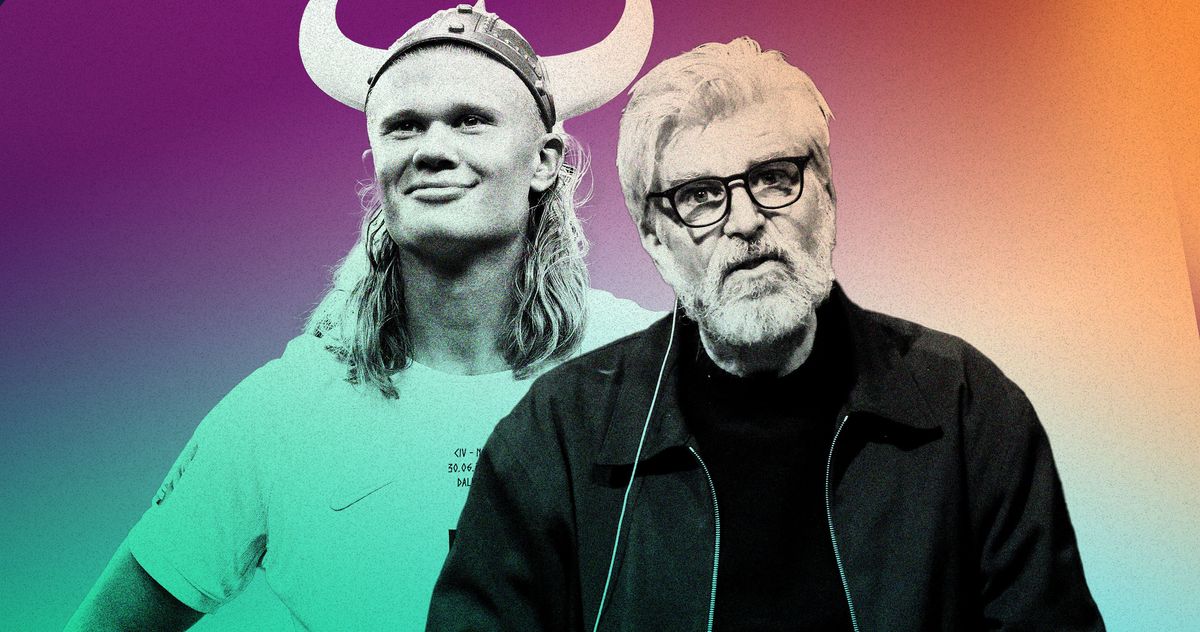

Haaland and Knausgaard.
Photo-Illustration: Intelligencer; Photos: Getty Images
Norway is not a traditional soccer power, but its arrival at the World Cup’s Round of 16 feels entirely expected. That is largely because of the team’s towering center forward Erling Haaland, a blunt-faced, flowing-maned phenom who you can easily imagine reaving enemy villages alongside his Norse ancestors back in the Dark Ages. Haaland transforms games with his centripetal force, the ball invariably finding its way to his giant feet or slab forehead before being caromed emphatically into the back of the net. He has scored five goals this tournament, just behind the Golden Boot leaders Kylian Mbappé and Lionel Messi. At 25 years old, he is already far and away the best player Norway has ever produced.
Haaland has also charmed North American audiences with his surprisingly sunny demeanor, posting videos of himself relishing a pastrami sandwich in New York and predicting, correctly, that Norway would lose to France in the group stage. (“They’re probably going to win the whole tournament,” he added, which at this point feels like another good prediction.) The Norwegian team has borrowed its talisman’s aura of joyful belligerence, posing as Vikings in a photo shoot, wearing horned Viking hats, and performing a “Viking row” after victories in which the players pretend to pull the oars of a ship to the quickening beat of a galley drum.
To get a sense of what this team means to Norway, a country now better known for free day care than bloody steel and animal skins, I spoke over video with its preeminent novelist, Karl Ove Knausgaard, who between tokes of his vape at his home in London exuded the enthusiasm of a longtime soccer aficionado. In addition to the autofictional opus My Struggle, which contains numerous scenes of young Knausgaard watching and valiantly trying to play football, he is the author of Home and Away: Writing the Beautiful Game, a series of letters with the Swedish author Fredrik Ekelund about the 2014 World Cup in Brazil. There, he writes what many of us are feeling now: “It was a perfect summer, as all World Cup summers are.”
This interview has been edited and condensed for clarity.
Norway plays Brazil on Sunday. What do you think of your chances?
I think Brazil actually will be an easier opponent than Ivory Coast because there was an expectation for Norway to win. But when it’s Brazil, there’s no expectation whatsoever. And then Brazil has a very slow midfield and didn’t play particularly well in their last game against Japan. And I do remember, and all the people of my age remember, the 1998 game against Brazil, which still is the glorious moment in Norwegian football. So it’s really, really nice to meet them.
You write about that game, when Norway shocked Brazil with a 2-1 victory in the group stage, in My Struggle and about how everyone streamed into the streets in delirium afterward. How is the current team different from that team?
The ’98 team was very, very well-organized. They had a kind of genius, mad-professor manager, Drillo. It was all about the collective, and he took them as far as I think a collective could go. This team is very different. They have so much individual quality that I never thought I would see in a Norwegian team. I watched football in the 1970s, ’80s, ’90s. I’m used to defense. I’m used to maximum three passes in a row. I’m used to losing 2-1 in Eastern Europe. Time after time, we never qualified for anything. And then all of a sudden, we’ve got this generation and they are really exceptionally good. So when they qualified, you know, we were happy. The rest is a bonus.
But were you surprised when they reached the Round of 16?
I didn’t think they would make it because Senegal is really good, but they played very well against Senegal. It was their best game. When I saw Senegal, I thought, Yeah, they’ll make it. And then I was dreading Ivory Coast. And I was right — they were very good. It was very painful to watch. Incredibly painful to watch. It’s sad because it’s almost better when your team is not in the World Cup; then you can just enjoy the football. But I can’t enjoy when Norway is playing. It’s impossible.
I support Japan, and during those games, I can’t even sit down. I’m standing the entire time, total anxiety enveloping me.
You had such an amazing team. It was such bad luck to get Brazil there. And also, you could have won. No, that’s a shame. That was one of my favorite teams, along with Morocco.
Thank you.
That’s the World Cup.
So we have to talk about Erling Haaland. Tell me what you think about Haaland as a player but also as a mascot for this team and the most visible Norwegian at the tournament.
I first became aware of him when I think he scored nine goals in a youth national team game. So it was something sensational surrounding him from the very beginning. He’s always had pressure, but he’s dealing with it in an amazing way. He’s funny, he’s friendly, he’s well-liked, he can play with his status. And he has got an extra star in my book because he bought a book, Snorri Sturluson’s saga. It’s this old Norse history book. It was worth millions. And he bought it and donated it to the library where he comes from. He does things like that. He cares about the people around him.
Of course, he’s got this commercial aspect to him. It seems like he is signing up to every major commercial enterprise in the world. But maybe he’s got ten years — there’s a window. So you can’t blame him, really.

Haaland the Barbarian.
Photo: Julian Finney/FIFA/Getty Images
And what do you think about his style of play? Do you think there’s something Norwegian about him, or is he just a unique talent?
Well, physically, he is Norwegian. But there’s something about him that’s very old-fashioned, very British. He’s like the strikers in the 1970s, when I started to watch football. The genius of him is the presence he’s got. I don’t know if you saw his missed chance against Senegal. He was down on the ground and his head in his hands. Then the play continued and he was up and almost scored the very next second. It’s his ability to switch on that is unique. He’s incredibly present. When he’s in the box, he’s probably the most aware man on the planet.
Of course, there’s his technique and his touch — he just shoots with one touch. He’s also got an acrobatic level to his shooting in the air. I don’t know if you saw Michael Olise against Sweden. He did a bicycle kick.
Yes, oh my God.
The technical level of that is magical, but that’s also what Haaland can do. A bit more awkward, not as elegant, but he can do those kinds of things.
Let’s talk about the other Norwegian standouts.
The right back, Julian Ryerson. He’s been injured, but he’s got incredible willpower. He’s absolutely 100 percent solid, and he is very fearless. And of course, Ødegaard, who is more like my type of player, really.
In what sense?
He can unlock a defense with one pass when he is at his best. Like the one he had against Senegal, through two defenders, exactly weighted so Haaland can just score. He was like a prodigy — he was playing against grown men when he was 11. My favorite player of all time is Andrea Pirlo. Ødegaard isn’t at that level, but he is the same kind of player who can create some magic not by dribbling or running on the wing but by passing.
And then there’s Sander Berge, the Fulham midfielder, the balance in the midfield. He doesn’t look good at first, but when you start to look at him, he looks better. And against Ivory Coast, our best player was Patrick Berg, Bodø/Glimt captain. He was absolutely brilliant, tactical, and wise. Another big surprise was the keeper, Ørjan Nyland, who got the save against Amad off the free kick. And Oscar Bobb is such a joy to watch — his through pass against Ivory Coast decided the game — and he is the only one of the players that I know of on the team that has read Dostoevsky.
What do you and other Norwegians make of the whole Viking thing?
Well, I can tell you, it’s very divided. You’ve got the more serious, intellectual newspaper side, who think this is terrible. The runic type on the back of their jerseys, they say it’s vulgar, it’s leaning towards right-wing aesthetics, Viking aesthetics. Because that was what happened in the 1930s and ’40s: When the Viking aesthetics went national, the Nazi party here used it. But I think it’s fun. It’s joyful, and it works. The Viking row thing is almost like a metaphor — we are in the same boat, all of us, and this World Cup brings us together, not only in Norway but all the other nations. And this is a symbol for that. And I think it’s good to take those aesthetics back to something fun instead of the right-wing thing. It’s very innocent, really. But, of course, it is a bit corny. I agree.
And if you were in the crowd, would you be doing the rowing as well?
Good question. I hope I wouldn’t be put in that situation. But I probably would. Yeah, I would.
After they beat Senegal, there were tens of thousands people out in Oslo. They all went to the castle and said, “We’re going to wake up the king. We’re going to wake up the king.” And they sat down and did a row in front of the castle. It’s been 28 years since we were at the World Cup, and that’s the kind of a thing we talk about occasionally: “Where were you then?” And it’s the same thing now.
This interview has been edited for length and clarity.
