
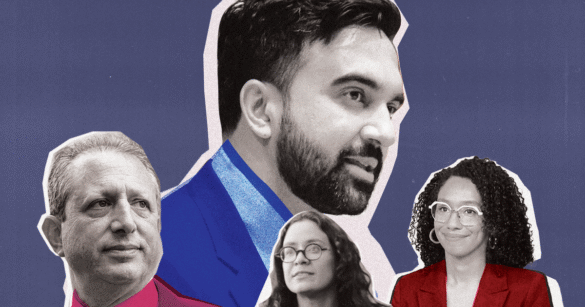

Photo-Illustration: Adam Gray/Bloomberg (Lander), nycmayorsoffice/Flickr (Mamdani), Selcuk Acar/Anadolu (Valdez), Spectrum News NY1 (Chevalier)
Zohran Mamdani was scheduled to show up to campaign with Brad Lander across the once punk-rock, now ultra-privileged, precincts around Tompkins Square Park one Sunday last month. But the mayor was missing, waylaid by other commitments, so Lander, the former city comptroller who ran against Mamdani before providing him with a crucial endorsement, knocked on doors alone in his bid to unseat Representative Dan Goldman.
A wealthy heir to the Levi Strauss denim empire, Goldman didn’t endorse Mamdani last year. He didn’t even vote for him in the general election — when most Democratic politicians fell in line — citing what he believed to be the socialist’s cavalier attitude toward antisemitism. Mamdani and his coterie were furious. The mayor endorsed Lander on the day he announced his campaign. “This is a district that voted overwhelmingly for Zohran over Andrew Cuomo, and the fact that our Democratic congressman could not vote for the Democratic nominee for mayor against Andrew fucking Cuomo pisses people off,” Lander tells me as he greets voters on Avenue A. “Obviously the mayor’s race did not go how I mapped it out, right? My goal was to win the mayor’s race. But the cross-endorsement did more than just defeat Cuomo. It opened up a sense of politics as a team sport.”
That spirit of camaraderie has defined Mamdani’s first months in office. He has mostly offered an outstretched hand to those who once opposed him — CEOs, House Minority Leader Hakeem Jeffries, the Albany Establishment, even President Trump. But during this year’s midterm races, Mamdani has shown where he is willing to flex his power, even if it makes some who backed him uncomfortable.
To endorse Lander against a sitting congressman was a bold move by a mayor who had not yet been inaugurated. In the months since, Mamdani has gone much further. He has been campaigning on behalf of Darializa Avila Chevalier, a doctoral student in sociology at CUNY who is embarking on an audacious run against Representative Adriano Espaillat, an uptown political fixture who is slated to chair a powerful Appropriations subcommittee in the next Congress. He’s also backing Claire Valdez, a one-term State Assemblymember who is running against Antonio Reynoso, the hand-picked choice of Representative Nydia Velázquez, a retiring incumbent who has led the city’s political left since the 1990s.
It looks a lot like a mayor merely rewarding those who were helpful to him. Valdez was a day-one endorser of Mamdani’s mayoral campaign; Chevalier knocked on doors for him. But inside the mayor’s political world is a clearer picture: He wants to fundamentally shift politics not just in the city but nationally. Mamdani is willing to make enemies (while gingerly appeasing local powers that could blow up his agenda) if it helps push Democratic Socialists of America candidates into Congress.
Most of the rest of the city’s political Establishment has not backed the DSA insurgents. Espaillat is a five-term incumbent who is the first Dominican, and first previously undocumented person, to serve in Congress. Reynoso is a 43-year-old Brooklyn borough president who has spent decades battling the entrenched machine politics of the borough. They both have been endorsed not only by Democratic Party stalwarts and labor unions but also by progressive institutionalists like Attorney General Letitia James. Almost all of these power brokers ultimately supported Mamdani during his 2025 campaign, and all have lined up against him in the midterms. Many of them privately urged the mayor not to get involved in the Espaillat race, to be mindful of existing relationships and seniority on Capitol Hill.
In the primaries, Mamdani’s moves have led to the usual debates about class and whom the Democratic Party should represent. Chevalier grew up in Florida and moved to the city to attend Columbia. After graduation, she participated in protests over the war in Gaza and attended a Times Square rally against Israel on the day after the October 7 attack. Valdez came to New York from Texas around ten years ago to try to make it as an artist but ultimately landed an administrative job at Columbia, where she became chair of the union representing the university’s office staff.
Their backgrounds have made for easy attacks from opponents. “Those that want to parachute in after the working men and women of the city have built our neighborhood, we’re gonna send them back home packing wherever they came from,” Espaillat told a rally days after Mamdani endorsed his opponent. It’s a refrain often heard across New York this primary season: We have been here, making these once dangerous neighborhoods the kinds of places where young people want to move, only to watch these arrivistes accuse us of being out of touch.
“Who are these people to tell us that we aren’t progressive enough?” asked one longtime activist and political operative. “It’s like they are paving over our people and planting their own because they think we aren’t good enough.”
Espaillat and Mamdani at first seemed to find a way to work together. The congressman endorsed the mayor after the primary — even as senior members of the congressional delegation, like Jeffries and Queens County boss Gregory Meeks, urged him to hold off. A member of Espaillat’s team said they received explicit promises Mamdani would return the favor in his own race. After the mayor’s inauguration, there was a delay; Mamdani’s team said the mayor wanted to wait before commenting on any midterm race. Then Mamdani balked again, Espaillat’s camp said, and the mayor promised only that he would stay neutral. But once Chevalier gained momentum, the mayor backed her, feeling pressure from the DSA base to get involved. “He sees it as a betrayal,” said one Espaillat ally of the reversal.
This year’s midterms are a test of whether the mayor’s influence can be used to replace even liberal members of Congress with fellow socialists. Velázquez, who was the first member of the city’s congressional delegation to endorse Mamdani, met with the mayor-elect after his victory and told him she was going to retire. She wanted to work together on who would replace her. City Councilmember Tiffany Cabán — a Puerto Rican member of the DSA — was thought to be someone both could agree on. But Cabán had been skeptical of Mamdani’s mayoral campaign, and the DSA and Mamdani pushed for Valdez instead. Cabán passed on the race.
Velázquez was frustrated. She barely knew Valdez and decided to support Reynoso. “I made it clear to Zohran from the beginning that I wanted to have someone who was rooted in our community and someone who was alongside me my entire political career,” Velázquez said earlier this month at a rally for Reynoso. “I even suggested some other Puerto Rican socialists who were part of DSA, but that didn’t work. So here we are.”
Despite the rifts, candidates whom the mayor endorsed against have been muted in their criticisms, mainly because of Mamdani’s popularity. One recent poll gave him an astonishing plus-78 approval rating in Valdez and Reynoso’s district. In Goldman’s district? Seventy-nine percent of people have a favorable view of the mayor. Goldman’s camp has been privately insisting that although Mamdani endorsed Lander, it was more out of obligation than affection. A Working Families Party phone bank urged listeners to support Reynoso so he could back Mamdani’s agenda in Congress.
It is a general rule of politics that newly elected leaders have only a limited amount of political capital and must be careful how they spend it. Mamdani is trying to use his to expand the role and power of the DSA in Democratic Party politics, even if it upsets putative allies. It’s a gamble. Win and it cements the mayor as a national political figure heading into the 2028 presidential election. Lose and he has created a squadron of lawmakers with bruised feelings who will be looking for revenge.
