
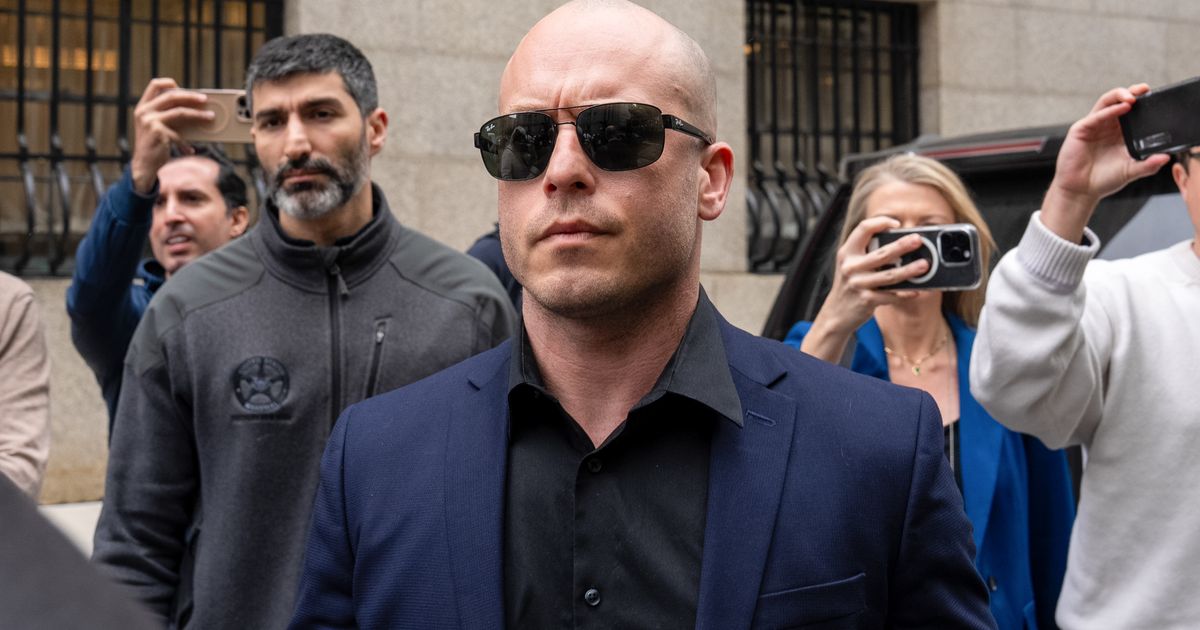

Gannon Ken Van Dyke, a U.S. Army soldier, exits federal court in New York on Tuesday, April 28, 2026. Van Dyke was charged with using classified information about the timing of the capture of then-Venezuelan President Nicolás Maduro to make more than $400,000 trading on Polymarket’s prediction market, the Justice Department said.
Photo: David Dee Delgado/Bloomberg/Getty Images
Welcome to the new age of insider trading. It’s not only for the Gordon Gekko–type Wall Street barons anymore; now it’s for the Jason Bournes, too, and potentially for everyone else. The big question moving forward is whether the Justice Department will choose to apply the law to the crooked Mayor Quimby–esque politicians who appear to be profiting the most.
Last week, the DOJ indicted Gannon Ken Van Dyke — a master sergeant with the U.S. Army Special Forces team that captured Nicolás Maduro in Venezuela in January — for insider trading and related federal crimes. In late December 2025, one week before the Maduro raid, Van Dyke allegedly opened an account on Polymarket, a leading online prediction market that enables users to place bets on anything from sports and politics to the existence of aliens (currently pegged at a mildly unsettling 20 percent likelihood by the end of 2026) and the return of Jesus Christ (trading at 4 percent).
In the days before the military operation, the indictment charges, Van Dyke placed a series of 13 Polymarket bets totalling more than $33,000 on the proposition that Maduro would be removed from power and that the United States would use military force in Venezuela by the end of January 2026. After the successful military operation, Van Dyke cashed out for more than $409,000, nearly all of which he promptly transferred to a foreign cryptocurrency wallet.
Although an insider-trading charge feels incongruous when applied to a soldier rather than a CEO, the facts seem to fit the law. The charged insider trading statute requires prosecutors to prove first that Van Dyke traded on “material, nonpublic information.” As a member of the U.S. Army’s Maduro raid team, Van Dyke surely knew about the plan in advance, and he plainly understood that that information was not only confidential but highly classified. Prosecutors also must show that Van Dyke had a “duty of trust and confidence” to protect the information. To that end, the indictment cites various documents in which Van Dyke acknowledged that he would be entrusted with classified information, and that he had a duty not to improperly use or disclose it.
But Polymarket itself is a complicating factor, and could give Van Dyke a technical hook for his defense: Prediction markets, the novel argument would go, do not qualify as “commodities” under the insider trading laws. Rather, Polymarket is simply a matchmaker. It connects “Yes” wagers with “No” wagers on any given proposition, and lets them have at it (while taking a small cut as commission). It’s no different, Van Dyke might claim, than two friends betting on a basketball game, or the Oscars, or anything else. And while there’s a broad public need to preserve the integrity of the stock market, the defense could argue, no such concerns apply to private, one-on-one proposition bets – especially in the unregulated, buyer-beware world of online prediction markets.
President Donald Trump weighed in quickly. When asked about the indictment, he observed, “Well, you know, the whole world, unfortunately, has become somewhat of a casino,” adding that he’s “not happy with all that stuff.” (It’s unsurprising that this man, who both built and destroyed Atlantic City, would recognize a casino even without the felt tables, clanging slots, and stale cigarette smoke.) In his commentary, the president displayed an awareness of modern prediction markets and their perils: they’re everywhere, and just about anyone can bet on just about anything.
But Trump sounded a note of sympathy towards Van Dyke. He opined that the soldier’s wagering on the Maduro raid is “like Pete Rose betting on his own team. Now, if he bet against his team, that would be no good. But he bet on his own team.” Rose is an odd point of reference for leniency, given that he was banned for life from baseball for gambling. And, of course, betting on one’s own team is no defense to insider trading. Imagine, for example, a pharmaceutical industry worker who knows that his employer has run successful clinical trials of a new drug and buys his own company’s stock expecting it to skyrocket. He’d be betting on his own team – and he’d break insider trading laws in the process. (Despite his spotty legal analysis, Trump’s supportive tone towards Van Dyke foretells a potential pardon, somewhere down the line.)
The Van Dyke case is notable because it applies insider trading charges far beyond Wall Street. And the indictment marks the first significant criminal charge based on activity on Polymarket, or any of its competitors. If there’s any surprise here, it’s only that it took this long for prediction market betting to cross over into the criminal realm. As Matt Stieb wrote in February, “It’s inherent to their business model: When you make a website where anyone can bet on anything, there is going to be someone with some nonpublic information ready to place a wager and make a killing.”
Indeed, virtually anybody who works in finance, politics, government, sports, media, law enforcement, the military, entertainment, or manufacturing likely has some morsel of confidential information that could provide an edge in the prediction markets, beyond opportunities for manipulation on the traditional stock market: a campaign volunteer who sees internal polling results showing a likely loss by a Senate incumbent; a stage technician who observes from sound check that the national anthem at the Super Bowl will run longer than 120 seconds; a personal assistant who learns that a high-profile couple is about to get divorced.
For all the problems posed by prediction markets, the risks are most acute on betting propositions related to politics, international relations, and war. Without aggressive enforcement, public officials entrusted with our most sensitive secrets might be tempted to rig an outcome through their on-the-job conduct. Or officials who hold classified information might simply cash in based on their access to information, as Van Dyke apparently did. Our adversaries, in turn, could monitor prediction markets for clues that might compromise U.S. intelligence and military operations. Imagine, for example, a Maduro advisor had noticed a sudden spike in Polymarket bets forecasting his imminent capture in the days before the military operation. Maduro could have been relocated, or his security forces could have prepared to ambush our troops on the ground.
The Van Dyke indictment also draws focus to the Justice Department’s larger enforcement priorities. While Van Dyke apparently turned a nifty profit for himself, his bets were relative child’s play. The day before the United States attacked Iran, prediction markets saw a sudden, massive spike in betting on an invasion. Weeks later, a $580 million surge in oil futures hit the stock market just 16 minutes before the president announced that attacks on Iranian power plants would be paused. And in late March, the White House issued a conspicuous advisory to staffers not to use inside information about the Iran war to place bets on financial or prediction markets.
It doesn’t take a prosecutorial sleuth to see the need to investigate. Yet, given the Justice Department’s recent history under Trump – vindictive aggression against political enemies coupled with willful blindness to wrongdoing within the administration’s power centers – it would be shocking to see criminal probes that might implicate true power players. And consider that the Acting Attorney General, Todd Blanche, is deep into audition mode for the permanent job. Blanche has already demonstrated that he will do nothing to upset the boss – especially not now, with his own shot at an AG nomination in the balance.
The Van Dyke indictment proves that the Justice Department knows of insider exploitation of prediction markets by government employees. The question now is whether this case heralds the start of a new, aggressive era of enforcement. Or will the case be a one-off, more or less, a showpiece that the administration points to – “See? We’ve done something!” – to justify broader inaction? The latter seems far more likely. If so, an unchecked problem will only get worse.
