

Photo: Kayla Bartkowski/Getty Images
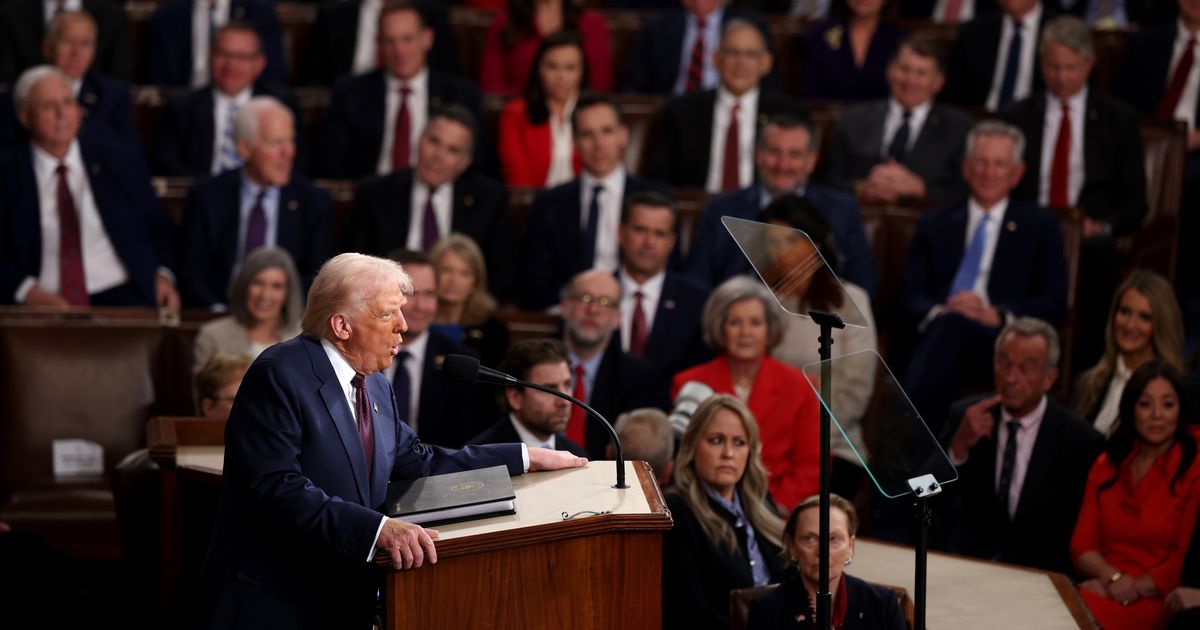
State of the Union addresses, like the one Donald Trump will deliver on Tuesday night, are a precious commodity for every president. The audience is typically large (roughly 36 million people watched Trump’s address to Congress last March). The trappings are imperial with members of Congress elbowing one another for a magic moment with the Boss as he slowly proceeds into and then out of the House chamber. Since Trump’s party controls the House, Speaker Mike Johnson and Vice-President J.D. Vance will stand behind him leading partisan cheers for his every utterance. The White House will be able to arrange for “real people” (often heroic military members and first responders or survivors of heartrending tragedy) to sit strategically in the gallery as human props for some point or other the president wants to make. And this year, the timing is just right to set the stage for the GOP’s midterm-election messaging as the Republican Party tries desperately to extend its control of Congress in November.
But as Politico notes, the timing is also pretty bad when it comes to the most recent news development:
The president’s primetime address to Congress on Tuesday was supposed to set the stage for a tough but disciplined midterm campaign focused on the administration’s efforts to lower costs for everyday Americans and tout his first-year accomplishments. Instead, he heads to the Hill amid a torrent of negative news.
Economic growth is flagging. U.S. military assets are massing in the waters around Iran in anticipation of a potential strike that many in the president’s base find odious. A major government agency is shut down over an immigration standoff with Democrats sparked after federal agents killed two U.S. citizens. “Make America Healthy Again” activists are furious over Trump’s order boosting domestic production of the herbicide glyphosate. The scandal surrounding Jeffrey Epstein, the late convicted sex offender, continues to swirl.
And on Tuesday night, Trump will directly face several members (we don’t know which ones just yet) of a U.S. Supreme Court that just invalidated the legal basis for his “Liberation Day” tariff program, to which he is intensely attached. He’s so infuriated that he is currently refusing to capitalize the words “Supreme Court” in his Truth Social posts. So the big question is whether Trump is capable of suppressing his rage at the various forces constraining him right now in order to make a coherent argument for keeping his party in control of the federal government in November.
The odds aren’t good. His address to Congress last March offered an ideal opportunity to smooth over some of the chaos and anxiety generated by the wild spree of executive-branch power grabs during the initial weeks of his second term and to arrest the steady decline in his job-approval numbers. Instead, he essentially delivered a MAGA-rally speech that pandered relentlessly to his own base, celebrated every step he’d taken as an unqualified success, and taunted Democrats with no real effort to persuade skeptics.
With the midterms approaching rapidly, the best guess is that his State of the Union address will provide a combo platter of what he needs to say and what he wants to say. The White House is already signaling that the speech will be very long:
Last year’s speech was the longest in the history of presidential addresses to Congress, coming in at 99 minutes, so you have to wonder what this White House means by a “long speech.”
Certainly, Trump will need a lot of time if he indeed intends to vent his rage while delivering a midterm message about his accomplishments, particularly on the economic front. But the two agendas may not smoothly blend. It won’t be easy for Trump to boast about having built the greatest economy in the history of the world while expressing his fury over the judicial sidelining of his favorite economic policy. It could be difficult to present an “affordability agenda” while maintaining that the cost of living is already low and public unhappiness with the economy is hallucinatory. And it may strain credulity to project a sustained administration- and party-wide focus on the economy while lambasting Democrats for shutting down DHS over their very popular demands to rein in ICE.
Even more fundamentally, Trump may struggle to make his SOTU remarks appeal to the sensibilities of the independent voters who are giving his second-term performance in office dangerously low marks or the 2024 Trump voters who have soured on him. With every fiber of his being, he wants to thrill his base and own his enemies. And if his script gives him any leeway to sing his favorite songs — as familiar as “YMCA” — about the depravity of immigrants, the senility of Joe Biden, the treachery of the U.S. Supreme Court, and the spiteful refusal of prize committees and voters to acknowledge his greatness, he may turn this set-piece speech opportunity into another ranting “weave.”
Democrats in his immediate audience will have their own disciplinary challenge: refusing to take his bait and respond in kind to his insults. House Democratic leader Hakeem Jeffries has instructed his troops to display “silent defiance” instead of noisy protests and to avoid the speech altogether if they cannot or will not control themselves (a growing group of House members plan to hold a counter-event). The official Democratic response to the SOTU address has been assigned to Virginia governor Abigail Spanberger, a stolid centrist who can be expected to stick to strongly polling topics, such as her party’s affordability proposals and the lawlessness of ICE.
The possible imminence of military action against Iran provides an irreducible element of unpredictability to Trump’s speech and the reaction to it. Will he announce a strike against Tehran, issue an ultimatum, or reassure Americans who consistently oppose distant wars that don’t appear to involve vital national interests? Whatever he plans to do, the president undoubtedly relishes his power to surprise and confound his critics. Unfortunately for him, he can surprise and confound his allies as well.
