
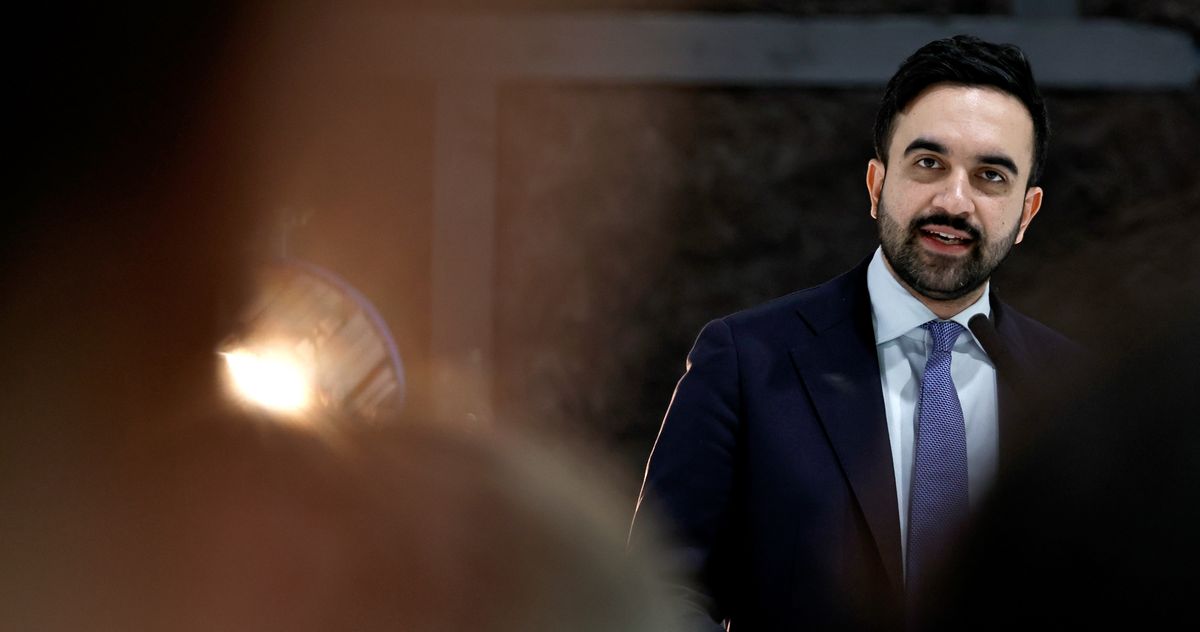

Photo: Michael Nagle/Bloomberg/Getty Images
Mayor Mamdani needs to listen to the grumbling members of the political class who are upset that he has not named a deputy mayor who is African American. Whether or not he makes such an appointment, Mamdani should understand the roots of that criticism. It is not simply about one person in one position — rather, the complaints spring from a deep worry about a decades-long mass exodus of Black families out of New York. A tectonic demographic shift is happening, one that is diluting and dissipating the Black political power base, built over the course of a century. Black political power helped Mamdani get into office. The mayor must understand that there are things he can do to help preserve it.
The numbers are stunning. “The city’s Black population has declined by nearly 200,000 people in the past two decades, or about 9 percent,” the New York Times reported in 2023. Harlem lost its Black majority in 2000 and saw nearly 11,000 Black residents depart between 2010 to 2020, gaining 18,000 white residents during the same decade. In Bedford–Stuyvesant, 30,000 white residents moved in between 2010 and 2020, while the Black population plunged by 22,000.
It’s part of a nationwide trend of Black populations shifting from northern cities to Atlanta, Houston, Charlotte, and other southern cities, in what the Washington Post describes as a reversal of the Great Migration that brought Blacks north throughout the 20th century.
“What I’m hearing from everyone is that the housing crisis that’s currently occurring has basically hollowed out many traditional African American or African diasporic communities and really represents a form of pervasive resegregation in many ways,” Professor Roger Green, who represented part of Brooklyn in the State Assembly for 26 years, told me. Greene and other older political-community leaders have formed a group, the Coalition for a Democratic and Just New York, that is pressing Mamdani to take action.
“We think that creating and enacting local laws that would enhance limited equity similar to the traditional Mitchell-Lama type of co-ops would be a step in the right direction,” said Green. “Sometimes those types of initiatives also create start-up homes, creating an opportunity for generational wealth for new homeowners.”
The Fort Greene and Clinton Hill neighborhoods that Green once represented in the legislature gave Mamdani his biggest majorities in the city, in what amounted to a huge swing from traditional support for former governor Andrew Cuomo, who finished second in the race for mayor. But they are areas that have been rapidly gentrifying for years.
L. Joy Williams, president of the NAACP New York State Conference, recently published the results of a survey of 600 Black New Yorkers that identified homeownership as a top priority. Relief from high rents was the greatest need, says Williams, but respondents identified supporting first-time homebuyers as the second-highest priority. “Our members want policies that turn renters into owners to close the racial wealth gap,” she says. Williams is among the leaders expressing concern that Mamdani isn’t getting the message. “It is clear from the lack of conversation and engagement that there doesn’t seem to be a lot of focus and attention on the needs of Black New Yorkers in the city,” she told the Times.
That’s not quite fair. Like every mayor before him, the Ugandan-born Mamdani, who is New York’s first South Asian and first Muslim mayor, is building a City Hall inner circle that reflects the coalition that brought him to power. His key appointees include First Deputy Mayor Dean Fuleihan, the son and grandson of Lebanese immigrants; chief counsel Ramzi Kassem, born in Lebanon of Syrian descent; budget director Sherif Soliman, the son of Egyptian immigrants; Faiza Ali, the daughter of Pakistani immigrants who runs the Mayor’s Office of Immigrant Affairs; and Ali Najmi, chair of the Mayor’s Advisory Committee on the Judiciary, who co-founded the Muslim Democratic Club and the South Asian and Indo-Caribbean Bar Association of Queens.
Black leaders, who chair four of the city’s five Democratic county organizations, were relatively late to support Mamdani: None endorsed him in last year’s primary, which cost them the ability to send lists of job-seekers to the Mamdani transition team for early consideration. High-profile Black appointees like Afua Atta-Mensah, who is the city’s chief equity officer, and Jahmila Edwards, the director of intergovernmental affairs, are not veterans of the Democratic clubhouses that snubbed candidate Mamdani. The Brooklyn, Bronx, and Manhattan party bosses, recognizing Mamdani’s support among younger Black voters, got onboard after the primary and helped cement his victory in November, adding a boatload of traditional Black leaders to the Mamdani coalition.
The boundaries, accents, and ethnicities of New York neighborhoods have been in flux for centuries, creating outcomes that somehow are both predictable and surprising. The wistful remembrance or angry lament of a community’s fading or changing culture — “It didn’t used to be like this” — is practically a subgenre of literature unto itself. As novelist Naomi Jackson recently noted in “I Miss My Black Brooklyn,” after buying a home in the Caribbean American brownstone community of Prospect Lefferts Gardens, “The neighborhood was already transforming; there was a new coffee shop and more white residents. Back then, the abbreviation PLG felt like a harbinger of gentrification that would protect my property value. Now, it feels more like a death knell for the childhood I remember.”
The larger African American exodus from New York may also be a death knell for the Black political ascendancy that has shaped modern city politics. Black officials, backed by active churches and community organizations, have spent decades patiently and strategically amassing a level of formal political power in New York that was unthinkable a generation ago. New York is the only state with Black leaders of both houses of the State Legislature, and one of only two states (alongside Virginia) with an African American chief judge. The city’s congressional delegation includes Hakeem Jeffries, who is the odds-on favorite to become the next Speaker of the House, and Governor Hochul’s choice of Adrienne Adams as her running mate puts Adams on a path to go from one history-making stint as New York’s first Black City Council Speaker to another as the first Black woman lieutenant governor.
But all that power stemmed from big numbers of active voters. As Blacks have gone from roughly one-quarter of the city’s population to less than one in five, the ability to swing elections is diminishing, and the trend will continue if Black families continue to flee the city and state. It’s already happening: Local officials often lament the declining numbers of young people getting active in traditional political clubs. Representative Gregory Meeks, who doubles as Queens Democratic chairman, recently complained about having trouble finding Black male lawyers who want to run for open judicial slots. “I’m going to be honest with you, that is what really depresses me right now: I cannot get African American men who want to go on the bench,” he told me. “I have zero that have come in to get interviewed” for possible party support.
Mamdani will continue to hear demands for Black representation in key strategic posts at City Hall, especially after the chaotic one-term mayoralty of Eric Adams. But the deeper reality is that Black political power, which helped lift Mamdani to victory, will continue to dwindle without a conscious effort to support and stabilize homeowners, a subject on which the mayor, thus far, has been relatively silent.
