
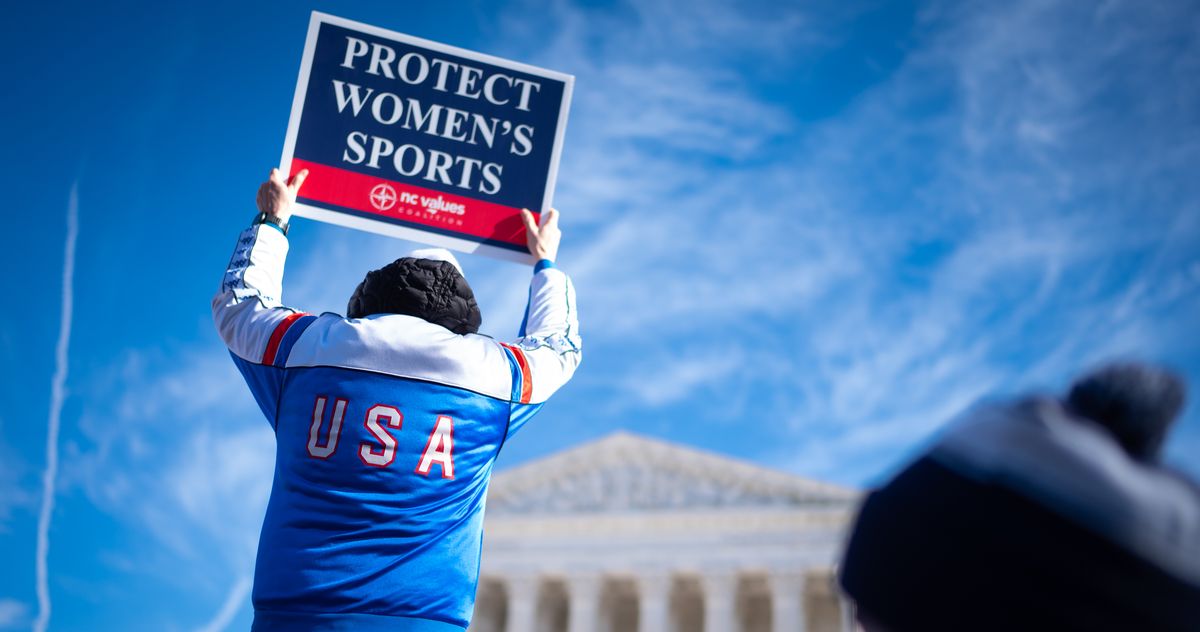

Photo: Sarah L. Voisin/The Washington Post/Getty Images
Sometime in 2018, Republican legislators became obsessed with fair play in youth sports. It started when a trans high-school student won a track-and-field championship in Connecticut and Idaho legislator Barbara Ehardt decided she couldn’t let the same thing happen in her state. Claiming that trans girls, whom she referred to as “biological boys,” had a competitive advantage in girls’ sports, she drafted a bill that would bar them from “interscholastic, intercollegiate, intramural, or club athletic teams.”
The so-called Fairness in Women’s Sports Act passed the Idaho state legislature in 2020 and quickly became a national model for the right. Republicans proposed nearly identical laws in 30 states, and Ehardt went on a national tour bankrolled by “pro-family” groups. One of her biggest backers was the Alliance Defending Freedom, the conservative Christian legal group that helped write Ehardt’s law and is best known for its work to overturn Roe v. Wade, ban gay marriage, and bar trans people from using bathrooms that match their gender. Conjuring images of innocent children being cheated out of trophies and ribbons, the ADF helped legislators pass bans in 29 states.
The truth is that as complex as the task of making sports truly gender–inclusive — or “fair” — might seem, there is limited evidence that trans girls possess any athletic performance advantages. A review of scientific literature published between 2011 and 2021, commissioned by the Canadian Centre for Ethics in Sport, found that to be the case even for girls who are not actively taking testosterone suppressants. Republicans are not pushing for more research (or, tellingly, advocating for any documented equity issues in women’s sports, such as those surrounding funding or pay). Instead, the bluster about fairness in sports has taken on a life of its own and become an obsession of the current administration. This past February, President Donald Trump issued an executive order revoking funding from schools where trans women and girls compete in women’s sports, making Ehardt’s law perhaps one of the most consequential pieces of legislation of the decade.
But the argument that these actions protect the integrity of sports has always been a convenient mirage, and the façade of “fairness” finally slipped this month when the Supreme Court heard challenges to two statewide bans on trans athletes.
One case, West Virginia v. B.P.J., was brought by a 15-year-old trans girl named Becky Pepper-Jackson, who runs high-school track and field and transitioned before hitting puberty. Instead of addressing how she could possibly have an athletic advantage under those circumstances, the appellate lawyer Hashim Mooppan, representing the government, called any argument about a level playing field “irrelevant.” The question of whether “taking testosterone suppression eliminates any physical advantage doesn’t matter,” he said. The issue at hand was the definition of sex in Title IX, the rule governing equal gender access in education. He argued that the Court should agree that sex in that law refers not to gender but only to sex assigned at birth, a move that would allow states to separate sports teams by sex assigned at birth.
That the Trump administration openly dismissed its own stated concerns underscores the disingenuous nature of the right-wing furor about fairness in sports and reveals the scope of the government’s aim and how wide-ranging a Court ruling on this could be.
Legal commentators largely agree that the Court seems inclined to uphold the bans on trans girls and women in sports when it issues its decision, likely in June. It’s possible a ruling that favors the government’s definition of sex and Title IX could allow legislatures and courts “to use this kind of ban toward trans women and girls in other areas of society, well beyond sports,” says Sydney Bauer, who writes about Olympic sports through the lens of gender identity.
If the Supreme Court can be made to say “a trans woman is a man on the sports field,” the Court can extend that same logic to trans women “applying for jobs or applying for houses and whether or not they can access gender-specific spaces in terms of rape counseling or hospitals,” Bauer says. “If you can get legal discrimination toward trans people in some aspect of society, it will be easier to expand to other areas, even if it contradicts existing civil-rights law.” Already, 27 states have used the precedent of sports laws to restrict trans kids from accessing health care.
The Trump administration isn’t waiting for the Court’s decision. With an eye toward the 2028 Olympics in Los Angeles, the State Department has said it will deny visas to trans women athletes seeking to enter the U.S., and on January 14, the Trump administration launched a probe of 15 school districts and three colleges that it says violate “women’s rights, dignity, and fairness” by allowing trans girls to compete in sports. Under pressure from Trump, both the NCAA and the U.S. Olympic and Paralympic Committee have already caved and banned trans women athletes from participating.
In doing so, the administration has seeded precedents that advance a right-wing feedback loop: During oral arguments, Justice Brett Kavanaugh pointed to the fact that the NCAA and the USOPC now bar trans women from competing as evidence that “allowing transgender women and girls to participate will undermine or reverse that amazing success” — omitting any mention that these groups were pressured to do so. The mere existence of anti-trans laws and policies, passed at the behest of right-wing groups, are now being offered as proof of their own legitimacy.
Female athletes have always been the subject of intense scrutiny, and sports are so interlaced with confused ideas of gender and sex that, at the beginning of the 20th century, newspapers like the Daily Herald insisted that athletic competition would turn women intolerably “masculine,” creating a “new type of human being, neither male nor female.” But perhaps the modern era of scrutinizing women’s bodies in sports started in 1936, after Helen Stephens, a cis American sprinter, won gold at the Berlin Olympics. European newspapers accused her of being a man, pointing to her biceps and deep voice as proof that she had transgressed the boundaries of femininity. Stephens’s gold medal stood, but a group of sports officials successfully whipped the controversy over her victory into the first policy requiring medical examinations of women athletes. Thereafter, track-and-field officials could strip test any woman about whom there were “questions of a physical nature.”
What followed were decades of criticism from doctors, including from the American Medical Association, that led elite sports bodies to largely phase out sex tests by around 2000. Now, because of the current anti-trans panic, they are embracing bodily surveillance once again. Next month, at the Winter Olympics in Italy, all women skiers and snowboarders will be forced to sit for DNA tests that would effectively exclude anyone with a Y chromosome from competition. The tests have also received endorsements from World Athletics and World Boxing; Kirsty Coventry, the new leader of the International Olympic Committee, has promoted a “scientific approach” to “protect the female category.”
The downwind effects seem imminent. Conservative activists in Washington State have submitted more than 400,000 signatures supporting a ballot measure that would require verification of a student’s biological sex, including genital inspections, to participate in school sports. A similar policy was included in the original version of Ohio’s bill to ban trans women and girls from school sports, though it was eventually spiked. While advocates frame these sex-testing policies as a way to safeguard women’s access to sports, increasingly, the opposite seems to be true. In Edmonton, Canada, a recent requirement that the parents of girls ages 12 and up present a form attesting that their child is “of the female sex at birth” led to a decline in enrollment. Rather than deal with constant scrutiny of their bodies, many girls may just opt to abandon sports entirely.
