
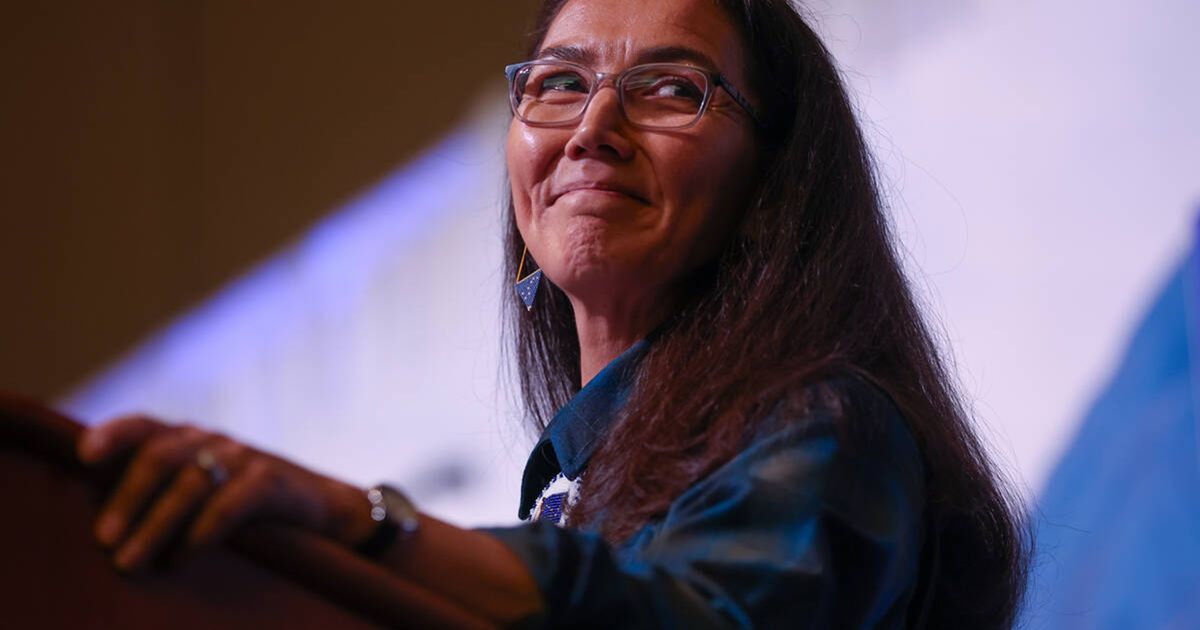

Former Palin-conquerer Mary Peltola of Alaska.
Photo: Ellen Schmidt/TNS/Getty Images
Going into the 2026 midterm election cycle, the conventional wisdom was that Democrats had no serious shot at gaining back control of the U.S. Senate. The party would need to flip four seats to restore the majority it lost in 2022. (Democrats currently hold 47 seats, and with J.D. Vance’s tie-breaking vote, the requisite number for control is 51.) And the 2026 map is forbidding: With only one Republican-held seat up for grabs in a blue state and two Democratic-held seats up in states Donald Trump won, the odds of the chamber switching hands have looked pretty long.
But Democrats have caught a few breaks in candidate recruitment. In Ohio, veteran Democratic senator Sherrod Brown, who narrowly lost his seat in 2024, is challenging appointed senator Jon Husted in what should be a close race if there is even a mild pro-Democratic breeze. In blue Maine, not one but two viable candidates — sitting governor Janet Mills and populist newcomer Graham Platner — are challenging veteran survivor Susan Collins. That’s also the case in Texas, where James Talarico and Jasmine Crockett are competing for a shot at the seat of beleaguered GOP incumbent John Cornyn, who is facing a wildly expensive and divisive primary fight with MAGA warriors Ken Paxton and Wesley Hunt. And in New Hampshire, Democrats dodged a bullet when popular former governor Chris Sununu again passed up a Senate campaign, leaving his less-popular elder brother, John Sununu, to compete with another former senator, Scott Brown, for a an uphill climb to win the seat of retiring Democrat Jeanne Shaheen. Similarly, Republicans aren’t necessarily offering their best and brightest candidates to challenge Ossoff in Georgia with popular GOP governor Brian Kemp declining to run.
The latest bit of good luck for Democrats comes from the unlikely frozen turf of the Far North. The most popular Democratic politician in that state, former congresswoman Mary Peltola, has announced she will challenge two-term Republican incumbent Mark Sullivan. As the New York Times notes, Peltola, like most Alaska candidates, is campaigning as an outsider who understands that state’s many peculiar needs and interests and its vulnerability to federal policies:
In her announcement video, Ms. Peltola made clear that she planned to position herself as a political outsider fixated on state and local issues like Alaska’s fishing industry and rising cost of living. She resurrected a slogan she used during her House campaigns — “fish, family and freedom” — and said she would propose term limits for members of Congress.
“It’s not just that politicians in D.C. don’t care that we’re paying $17 a gallon for milk in rural Alaska — they don’t even believe us,” Ms. Peltola said.
Peltola is best known nationally for having thwarted Sarah Palin’s comeback attempt in 2022 after long-time Republican at-large congressman Don Young died. As a centrist, she was extraordinarily well-positioned to exploit the state’s new election system that year, in which the top-four finishers in a nonpartisan primary advanced to a general election that utilized ranked-choice voting. In both a special election and the contest for a full term, she wound up matched against two strong Republicans, Palin and Nick Begich, and defeated Palin in the final round of voting. In 2024, she narrowly lost to Begich, but that was a presidential year in which Trump carried the state by 13 percentage points. The silver lining for Peltola in 2024 was that Alaska voters narrowly rejected a GOP-sponsored ballot initiative to get rid of the state’s novel election system and go back to partisan primaries.
So now Peltola can “run to the center” (her specialty) as much as she wants without worrying about a Democratic primary. She may also benefit from a combination of Democratic momentum this year and Alaska’s traditional hostility to Washington, where Sullivan has served two Senate terms after winning the seat in the great GOP year of 2014. Her ace in the hole is the fact that she’s the first Alaska Native to serve in Congress, which gives her an important voter base that transcends party. Sullivan has the advantage of a Republican majority in Alaska in most elections but doesn’t have anything like the image of independence that Sullivan’s senior Republican colleague Lisa Murkowski enjoys.
Speaking of Murkowski: She could be a factor in the 2026 Senate race. She is a long-time friend of Peltola’s (sharing, among other things, a strong Native voting base), and in 2022, when Murkowski last faced voters, the two women endorsed each other despite their different party affiliations. Murkowski endorsed Peltola again in 2024, even as she refused to support either major-party presidential candidate. But despite continuing to praise Peltola, she has now announced she’s backing Sullivan this year:
That puts Murkowski and Donald Trump on the same team in 2026, a position neither of them is likely to find comfortable. It’s a good guess that Murkowski won’t exert herself too much on Sullivan’s behalf, unless it really does become clear Senate control will be decided in Alaska. And if that’s the case, Democrats will have come a long way towards overcoming an adverse Senate landscape and smiting Trump and his party in more than one arena.
