
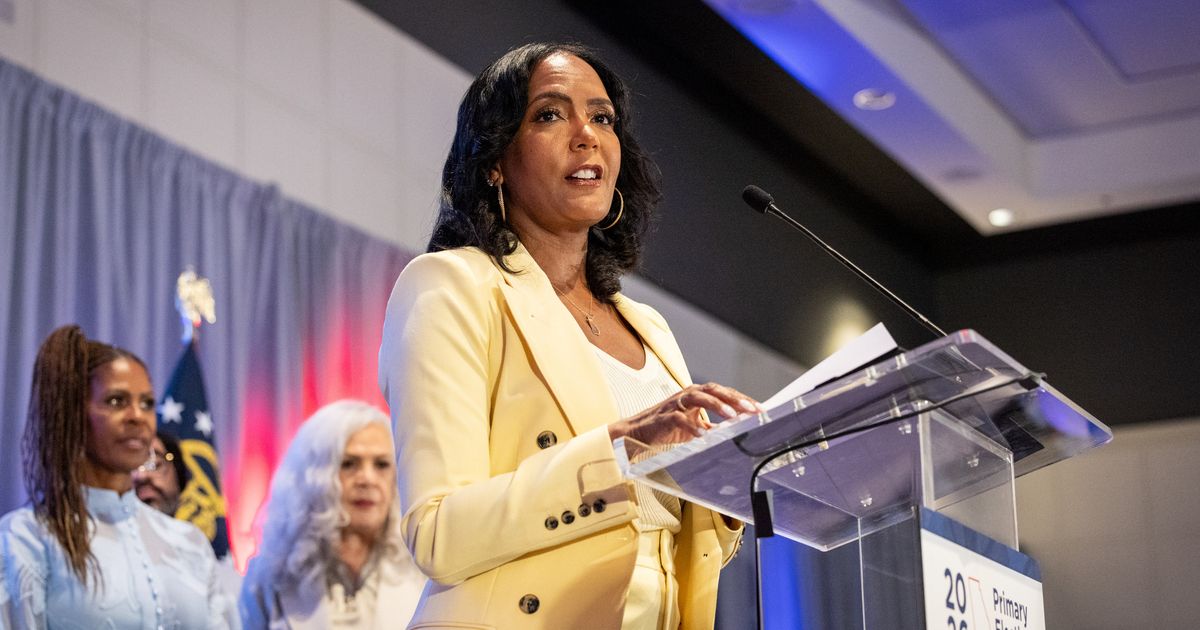

Georgia gubernatorial candidate Keisha Lance Bottoms speaks in Atlanta on May 19, 2026.
Photo: Dustin Chambers/Bloomberg/Getty Images
Twenty years ago, after two presidential elections in which George W. Bush won every electoral vote in the former Confederate states, there was a noisy debate among Democrats over the idea that the party should give up on the South altogether. The thinking, promoted most avidly by political scientist Tom Schaller in his book Whistling Past Dixie, was that the South was a hopeless proposition for any progressive party and that pursuing the chimera of southern comfort would inevitably mean kowtowing to the region’s militarism and atavistic cultural views. Indeed, wrote Schaller, Democrats should run against the South in the rest of the country.
Two years later, Barack Obama broke the GOP electoral-vote lock on the South by carrying Florida, North Carolina, and Virginia. And by 2020, Georgia was electing two Democratic senators (one Black, the other Jewish) with views difficult to distinguish from those of their party colleagues elsewhere. Yes, Republicans have generally maintained a strong hold on the region. But no one can credibly argue that competing there would compromise the party elsewhere, aside from adding to demands for dollars.
There are very good reasons for Democrats to aggressively engage in the South right now. For one thing, the region is rising in population and will accordingly gain clout after the next decennial Census. The Brennan Center predicts that after 2030, Florida and Texas may each obtain four more U.S. House seats, while North Carolina should receive one as well. This, of course, will also shift electoral votes in presidential contests.
But the rationale for the party to step up its efforts in the region goes beyond that cold practical calculation. Democrats have both a moral obligation and a political opportunity to respond to Republican attempts to monopolize legislative representation through the racially minded partisan gerrymanders encouraged by the U.S. Supreme Court decision in Louisiana v. Callais. Millions of southern Democrats, particularly Black voters, could lose nearly all their influence in states where Republicans hold governing trifectas (and thus the power to draw maps that give the GOP unanimous congressional delegations and supermajorities in state legislature). Fighting back by devoting national Democratic resources to viable southern gubernatorial candidates (e.g., Georgia’s Keisha Lance Bottoms) and prioritizing state legislative races would go a long way toward addressing long-standing concerns both in and beyond the region that the party takes Black support for granted. Plus, busting up a few GOP trifectas in 2026, 2028, and 2030 would safeguard against a gerrymandering bloodbath now as well as when the maps are all redrawn in 2032.
There are signs that Democrats are willing to fight GOP efforts to monopolize southern political power. The party’s need to make a show of force in the South is entering into decisions about the 2028 presidential-primary calendar, as Politico reports:
As Democratic National Committee members meet in D.C. this week to discuss which states will lead the next presidential nominating contest, the GOP push to dismantle majority-Black districts and dilute Democrats’ power across the South is ratcheting up the selection stakes. Some members are now advocating for two southern states to make the cut as the Callais ruling adds fresh urgency to Democrats’ long-running debate over how to amplify the voices of Black voters who have long been the party’s backbone.
Beginning the presidential primaries in, say, New Hampshire, or even in Nevada as Republicans are decimating Black representation in the South might not be a very good look in the eyes of the most loyal Democratic constituency. But down the road, Democrats might envision a true comeback in the South wherein Black — and in some states, Latino — voters build a high floor for a Democratic electorate that is no longer an outmatched minority. To fuel that revival, the party could turn to the same variable that won 10 southern states in 1976 and four in both 1992 and 1996: a southern Democratic presidential nominee. There is already some talk about Jon Ossoff as a potential 2028 candidate (assuming he holds his Senate seat in this year’s election). It’s easy to imagine his Georgia colleague Raphael Warnock appearing on lists of potential presidential contenders as well. And if Bottoms wins the governor’s race, she could join the senators in the national spotlight.
Above all, serious Democratic competition in the South would prevent Republicans from consolidating an unshakable regional base and then intensifying it through gerrymanders, making it perpetually easier for the GOP to get to 218 U.S. House seats, 51 U.S. Senate seats, and 270 electoral votes. If Democrats are truly determined to rediscover their party’s heritage as one that speaks to all Americans, they can begin to prove it in the tough but rich terrain of the South.
