
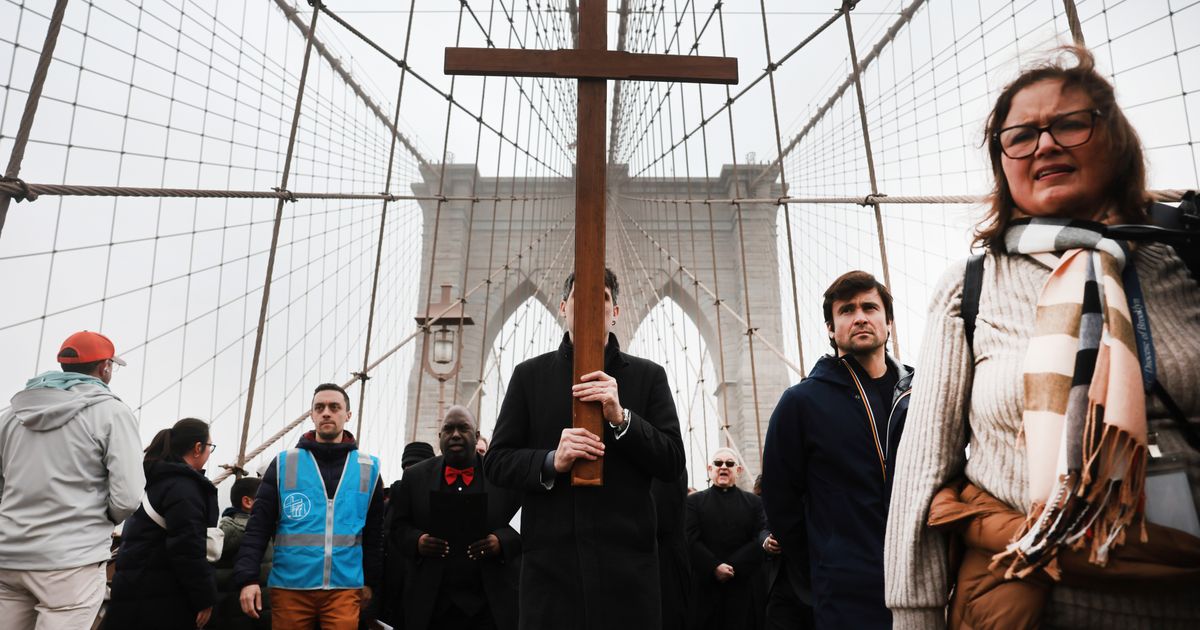

Worshippers walk to a station during the Way of the Cross procession over the Brooklyn Bridge on April 03, 2026 in New York City.
Photo: Spencer Platt/Getty Images
Have you heard the good news? God is back, and He’s speaking to Gen Z. In Greenwich Village, 20-somethings fill the pews of St. Joseph’s Church in search of spiritual truth, or a date, or both. Christian student clubs at Ohio State University say attendance has doubled. “We’re seeing baptisms on college campuses” along with “a hunger for reverence” and “a return to Christianity,” Evie magazine gloated. Lifeway, a Christian nonprofit, credits young adults with a rise in Bible sales. Some Orthodox parishes are reporting a flood of young men, or “Orthobros.” Earlier in April, St. Isaac Jogues Catholic Parish in the Chicago suburbs said converts had risen by 124 percent since last year. The Archdiocese of Boston has welcomed almost 700 new Catholics since 2022, including many of them young people, leaders tell CBS News. On Easter, members of V1 Church, a large charismatic congregation, packed Times Square to celebrate the risen Christ. In videos, the crowd looks diverse and youthful.
If a revival is underway, as many claim, it would defy conventional understandings of religious identity and the future of Christianity. In one story, America is becoming more secular as Christian traditions lose their young. Research has shown that millennials are less religious than their forebears, and Gen Z is less religious still. Now, headlines say otherwise. Young adults are rediscovering church and the value of faith in an unsettled world. Among them are young men who want families and masculine role models.
But there is no empirical evidence for a sustained Christian revival in the United States — among members of Gen Z or anyone else. True revival would be hard to miss, says Ryan Burge, a demographer and the author of The Nones and The Vanishing Church. In 2024, about a quarter of Americans said they attended church every week. Even a 3 percent rise in that figure could constitute a “modest revival” with around “12 million new people going to church that weren’t a year ago,” Burge explains. That isn’t happening, and adults in their 20s aren’t more observant than millennials.
Instead, the American church has, for some, become a proxy for a broader political project. So far, the most triumphant tales of revival are coming from the right: Evie is funded by Peter Thiel, a far-right billionaire with an Antichrist fixation. Lifeway is part of the Southern Baptist Convention, which forbids women from becoming pastors. The founder of V1 Church, Mike Signorelli, says he met with Donald Trump during Holy Week, and MAGA influencers spread videos of his Times Square service online. His “stand” in New York City, that pit of godless villainy, “shows real revival is possible,” one influencer claimed. Last September, Elon Musk, formerly an atheist, shared a message from Erika Kirk urging Americans to “go to church,” and in June, J.D. Vance will publish a memoir about his conversion to Catholicism. Jordan Peterson, the U.S.-based culture warrior, owns a suit jacket covered with Orthodox-style iconography.
The right owns the White House, but it hasn’t won the church yet. Church attendance is up in some places, earning trend pieces in the Washington Post and the New York Times. The Orthobro phenomenon is real, if small, and it is driven by right-wing politics. But not all converts are reactionaries, and a surge in one diocese or parish or congregation can occur without leading to national growth. Before the Gen-Z revival-that-isn’t, the story of the church was one of decline. Against that backdrop, revival claims look more like backlash.
Before Dave Kinnaman and Gabe Lyons published unChristian in 2007, there was an air of triumphalism on the campus of my Baptist college. Sure, the secular world was out to get us, but we’d elected George W. Bush twice. We were going to liberate Iraq and save the unborn and convert the lost to our cause — except maybe not. Kinnaman and Lyons, both Christian researchers, found that young adults raised outside the faith had little interest in joining us. Among these “outsiders,” the “three most common perceptions” of Christianity were that we had become “anti-homosexual,” “judgmental,” and “hypocritical.” The picture didn’t look much better inside the church. “Four out of five” Christians my age said the church “is anti-homosexual,” while half believed it to be “judgmental, too involved in politics, hypocritical, and confusing.”
By the time I interviewed Lyons for our student newspaper, I’d come to agree with most criticisms of my faith. I clung to bits of it for the next few years but moved left, toward pacifism and feminism, and ditched my anti-LGBT beliefs altogether. I was not the only student with questions, either. Some classmates drifted toward a harder-edged Reformed tradition because it sounded more rigorous than whatever we were doing in chapel. Others just drifted. I stopped going to church. I thought about Wicca. Soon I concluded there was no God at all. In demographic terms, I’d become a “none” — religiously unaffiliated — a fast-growing category at the time. Millennials at the cusp of adulthood were far likelier than any prior generation to reject a religious affiliation, and years later, we are still less observant than our elders.
Most “nones” have supernatural beliefs, though a minority, like me, are atheist or agnostic. Overall, we tend to be more left-wing than our counterparts. As we liberalized, some factions fought even harder to tie the church to right-wing politics. “Softening or reshaping the gospel is an utterly wrong response to the objections people raise,” wrote Kinnaman and Lyons, and that view had real demographic consequences. According to a 2014 report from the Public Religion Research Institute, one-third of millennials who left their childhood faith did so because of its treatment of LGBTQ+ people. By 2015, Pew found that over a third of millennials were religiously unaffiliated. Twenty-one percent said they were Evangelical Protestants, 16 percent were Catholic, and 11 percent said they belonged to mainline denominations, like the Presbyterian Church (USA). Then Donald Trump rode Evangelical support to the presidency, and Gen Z came of age amid a new moral crisis for Christianity.
In some respects, today’s young adults resemble my generation, but there are a few important distinctions. One Pew report says they’re “less religious” than young adults were a decade ago, and in other data, they’re more likely to identify as LGBTQ+. As a result, counternarratives tend to stand out. In 2023, Christian media reported a kind of mini-revival at Asbury University in Kentucky. Students spent hours in prayer, transforming one chapel service into “a 16-day event,” as the school’s president, Kevin Brown, later wrote in Christianity Today. Thousands of believers descended on the town as news spread on social media; even the New York Times took notice. Some called it a revival, though the term inspired some debate. Burge, the demographer, visited campus a year after the event. “The follow-up to that story is the churches and pastors in Asbury have seen nothing change in terms of long-term attendance,” he tells me. The aftermath of a revival would be “sustained,” he adds. “It wouldn’t just be an emotional outpouring for two, three weeks.”
The revival story wants Gen-Zers to be Christian in a way they clearly aren’t. Their religious habits are more like those of millennials than boomers. Greg Smith, a senior director at the Pew Research Center, says that each new generational cohort “has grown less religious over time,” as older, more observant demographics fade away. Still, the overall trends are complicated, he cautions. Although there is no revival, the “nones” aren’t growing the way we once were, and gender helps explain why. Women have historically attended church more often than men, but that gap has begun to narrow with Gen Z. In the press and on social media, the religiosity of young men is the focus of much scrutiny and it is linked, often, to the radicalization of the right wing. Orthodox Christianity “appeals to the masculine soul,” but “Protestant and Catholic churches have a very feminine atmosphere,” a college student told the New York Times last year. That logic may influence some young men, but not all, or even most. The real story isn’t that Gen-Z men are “coming back to church,” Burge says, but that “they’re leaving church more slowly than Gen-Z women are.”
By some metrics, Gen-Z women are the most left-wing group in the United States. Melissa Deckman, a political scientist and the CEO of the Public Religion Research Institute, tells me young women are more politically engaged than their mothers and grandmothers. They lean more feminist, and they’re more supportive of abortion rights. “You have a generation of young women, I think, that believe they have agency, and they believe in their ability to do all sorts of things in life,” she says. “For a lot of these women, they see a church that is opposed to LGBTQ rights and that’s increasingly patriarchal in its language and orientation.”
There are Christian denominations and traditions that ordain women and affirm LGBTQ+ rights, but they’re shrinking at a fast clip. Burge has written that for Americans born during the last 40 years, religious activism is primarily “tied up with the Religious Right.” Conservative Christianity is good — very good — at grabbing media attention, not entirely without reason. The secretary of defense is linked to a pastor who wants to repeal women’s suffrage. Trump would not be president without the adoration of white Evangelical voters.
I reached out to my friend Daniel, who converted to Christian Orthodoxy about 16 years ago. Like me, he grew up in Evangelical churches and attended a small Christian college, which soured him on the tradition we shared. He now attends a Russian Orthodox parish in the Washington, D.C., area, and he has noticed more young adults in the pews. “We do have a lot of African American and Asian converts,” he tells me, “but it’s still majority white guys, and they’re very interested in the masculinity of Orthodoxy.” They seem drawn to the church for the all-male priesthood and what Daniel describes as “male headship of the family” and “a little bit of militarism.” He worries about the popularity of influencers like Jay Dyer, a conspiratorial, Orthodox YouTuber who regularly appeared on Info Wars. “My experience has been that in-person community is so important, and for a lot of these people, it’s the online community that is important,” Daniel says, and some new parishioners have extreme views. Last year, Daniel was supervising altar servers when he overheard them discussing the mayoral election in New York. One, a newcomer in his late teens, “started saying, like, ‘Oh, I can’t believe they’re electing a Muslim,’” Daniel says. “Then he said something like, ‘It’s the Jews who are really doing this,’” and said he’d “watched this video about how the Jews lived in the sewers down there, all this antisemitic stuff.”
Daniel is careful not to generalize about prospective converts to his church, who aren’t all extremists, and he doubts the radicals will stick around over the long term. The formal process of conversion is not quick or easy, and the reality of parish life is much different than social media. “Once they start living in the community, and they start encountering people who are different than they are, it’s going to turn them off because we aren’t living these epic lives owning the libs,” Daniel says. A Greek Orthodox woman tells me Orthobros have been around longer than Gen Z and so has their online extremism. “I think young men are coming into the church probably thinking they’re going to find a nice Orthodox wife who is, I don’t know, submissive or something,” she says, and that doesn’t always work out the way they’d like, even in a conservative tradition. Still, “those people are sometimes going to get what they want, because let’s face it, the Orthodox Church is still very, very patriarchal,” she adds.
But Orthodoxy, she explains, “is a living and breathing thing, and as much as you think churches don’t change, they have.” The future of Christianity is up to billions of believers, not conservatives alone, and entangling the church with hard-right politics may cost them the very dominion they seek. “I’ve done all kinds of analyses of young women. They’re not buying it,” Deckman says. “And that, of course, is just driving the far right to double down on tradwife content.”
To Burge, a true Christian renaissance “would take something supernatural.” Other Christians say that it would be unpredictable if it ever occurs. “Revival cannot be controlled; it can only be received,” Russell Moore, the editor-at-large of Christianity Today, wrote last year. Until then, the life of the church goes on, far from the public spectacle, and the headlines, and the online debates. It is not so easy to define or control. “One of my favorite descriptions of the church is that we’re not a college of saints, we’re a hospital for sinners,” Daniel says. “We’re not this perfected collection of saints who have all the answers. And I think that vision of the church conflicts with what these guys want.”
