
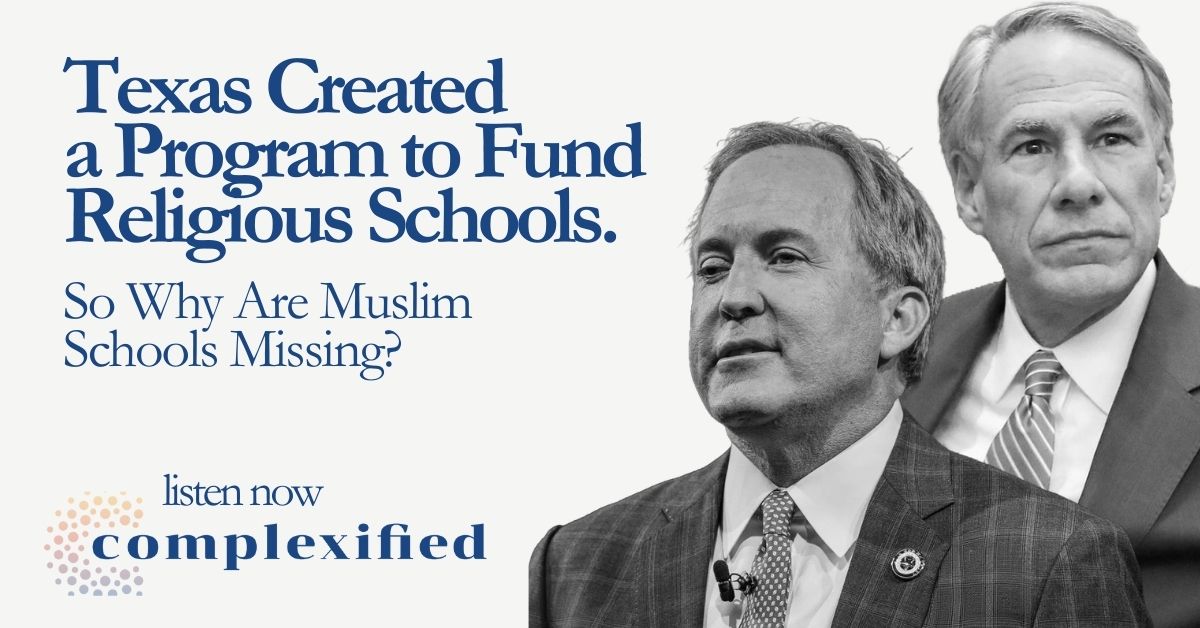
Muslim families in Texas are asking: Does school choice include us?
A Houston-area father went to enroll his kids in Texas’ new school voucher program and discovered their school wasn’t on the list — along with every other Islamic school in the state. Texas launched one of the country’s largest school choice programs, promising families public funds for religious private schools, but roughly a hundred Muslim schools were excluded without official explanation. State officials have posted publicly about not funding schools tied to terrorist organizations, pointing to Gov. Greg Abbott’s designation of the Council on American-Islamic Relations as a foreign terrorist organization — a designation the federal government has not made. Now families are suing. Amanda Henderson talks with RNS reporter Fiona André and Editor-in-Chief Paul O’Donnell about the lawsuits, the communities affected and what this moment reveals about who “school choice” was really built for.
This transcript was created using AI tools and may contain minor transcription errors
AMANDA HENDERSON: From RNS and the Institute for Religion, Politics, and Culture, this is Complexified, a podcast for the religiously curious and politically frustrated. I’m Amanda Henderson.
A program designed to help families send their kids to religious schools is now being accused of excluding one religion entirely. Earlier this year, Texas launched one of the largest school voucher-style programs in the country. The idea was simple: public funds that families can use to pay for private education, including religious schools. For years, supporters of these programs have argued that if the government offers money for education, it can’t exclude schools simply because they’re religious. But when the program opened and families began looking for their own schools, something strange started happening. Islamic schools across Texas weren’t showing up on the list. Confusion quickly turned into lawsuits, with families arguing that Texas is doing exactly what the Constitution forbids: excluding a religious community from a public program.
So what’s actually happening here? Today I’m joined by Fiona André, a reporter with Religion News Service who’s been covering the lawsuits and the families behind them, and Paul O’Donnell, editor-in-chief of RNS, who’s been writing about school vouchers and religious schools for more than two decades. Fiona, Paul, welcome to Complexified.
FIONA ANDRÉ: Thank you.
PAUL O’DONNELL: Glad to be here.
HENDERSON: Fiona, when the Texas voucher program opened earlier this year, a Houston father went online to sign up and something surprising happened. What did he discover?
ANDRÉ: When the application opened on February 4th, Mehdi Cherkaoui, who has two children enrolled at the Houston Qur’an Academy, realized that his kids’ school was not among the eligible schools. And not only that, but news reports showed that no Islamic school in the whole state was among the eligible schools for the program.
HENDERSON: That’s a big impact. So explain what the Texas Education Freedom Account program actually is.
ANDRÉ: It’s a program that was passed by the state legislature in 2025 and the goal was to give more freedom to families to choose where they would send their kids to school. Officially, they wanted to increase access to private schools and give opportunities to children from low-income families and also students with disabilities to be able to afford the tuition of these private schools.
HENDERSON: So essentially this program is a type of school voucher — public money that follows the student and can be used to help pay tuition at private schools, including religious ones. And so this dad looks to the list to see the schools so he can sign up, and his school isn’t there. He finds out that he’s not alone, that there are many Islamic schools that are not on the list. What did they start to realize as conversations started to happen among their community?
ANDRÉ: It was kind of unclear at the beginning because there was no official communication saying that this school has been banned because it’s an Islamic school. So I would say there was a lot of confusion. They obviously realized that something was wrong, but because there was no clear statement specifically for the schools that were not approved indicating the reasons, they were just really confused.
HENDERSON: At what point does this turn into a legal fight?
ANDRÉ: They all realized that it’s because of their schools’ religious affiliation. And they know that because before the application opened, the state comptroller sent a letter to the state attorney general, Ken Paxton, asking him basically if it would be legal to exclude schools with — quote — “ties to foreign terrorist organizations” from the program.
HENDERSON: So who is making these ties to terrorism, and what exactly are they saying?
ANDRÉ: He sent this letter with one school particularly in mind. They’re relying on a decision by Governor Abbott in November, where he designated the Council on American Islamic Relations — which is a Muslim civil rights group — as a foreign terrorist organization. What the state comptroller, Kelly Hancock, was saying was that one Islamic school in Texas had hosted an event for CAIR, and he was raising concern that if that school was included in the program it would receive taxpayer funds — which, in his view, would be sending money to a school with ties to a terrorist organization. So they’re all pointing back to that one decision by Governor Abbott.
HENDERSON: Just to pause there for a minute. The Council on American Islamic Relations — CAIR. The federal government doesn’t designate them as a terrorist organization. But Texas Governor Greg Abbott did that under state authority, which is what they’re now calling upon to raise concerns about Islamic schools.
Paul, let’s step back for a moment. Voucher programs are often framed as expanding freedom in education. Why do supporters make that argument?
O’DONNELL: It goes back to the origin of school vouchers as an idea in American education. They were developed in the 1950s and ’60s as a sort of end run around desegregation, which had been ordered by the Supreme Court. Rather than explicitly say that school funding was now going to be offered to private academies for racial discrimination reasons, they portrayed it as giving parents a choice over what school they were going to send their kids to.
HENDERSON: But in the modern version of this debate, voucher supporters often frame these programs as expanding religious freedom — the idea that if the state funds private education, it shouldn’t exclude religious schools. Fiona, back in Texas, how do officials appear to be justifying keeping Islamic schools out?
ANDRÉ: Well, officially they’re not really saying that that’s what’s happening. As I said, there’s a lot of confusion around all of this because these schools are just left with a lot of unanswered questions. Some of them were pre-approved and then removed from the list, so they don’t know exactly why. They didn’t receive a letter saying it was because they were Islamic schools. On social media, Comptroller Kelly Hancock, Governor Greg Abbott, and Attorney General Ken Paxton have been posting a lot — specifically on X — about not wanting taxpayers to fund schools with ties to terrorist organizations. They also mentioned foreign enemy governments, talking about schools associated with the Chinese Communist Party. Even though these schools and these parents didn’t receive direct communication from state officials saying this is what’s happening, they suggested it heavily in their public comments.
HENDERSON: And Paul, what is the political context in Texas that this situation is coming into?
O’DONNELL: This bill took an enormous effort by Governor Greg Abbott, who spent a tremendous amount of political capital to get it passed. His fight for it really began in 2022. He had never been a huge proponent of school vouchers, but the moment seemed ripe after COVID-19, and he was backed by a lot of conservative Christian money — foundations and private billionaire backers. It took him essentially until now to get it passed. He had to really twist a lot of arms in the legislature. He toured the state holding parent empowerment nights at local schools and other venues. He brought the legislature into special sessions numerous times and in the end had to appeal to President Trump to make calls — essentially to make threats to Texas state legislators and tell them they had to vote for the bill or risk their position in the Republican Party.
HENDERSON: So there’s been this long effort to pass this bill — a big political push to allow for school vouchers by folks who probably largely assumed this was going to benefit their own communities, conservative Christian communities. And there have been unintended consequences to this bill that they pushed.
O’DONNELL: Right. And the history of vouchers is that they don’t always benefit the schools or the populations that you expect them to. Back in the early 2000s, when school voucher programs got new life because of a set of Supreme Court decisions that lowered the barriers for public funding to be spent on private education, I wrote a piece that showed that actually Muslim academies would be one of the biggest beneficiaries — because they are often underfunded and are still growing. They’re adding seats, and this would allow them to pull in new students.
HENDERSON: But here in Texas, in this situation, it looks like Islamic schools are being excluded. Fiona, what are the families and schools saying this situation is doing to their communities right now?
ANDRÉ: Well, I think beyond the financial aspect — because the program would give them up to $10,000 per student — the people I spoke with told me it’s also a question of reputation. Because even if a court ruling says that there is indeed religious discrimination, the way it tarnishes the reputation of the schools and of their community is going to probably last for a long time. That’s what they were talking about. The whole idea of being associated with terrorist organizations, as the state officials are saying, is obviously a stain that’s going to remain for a long time for this community. And right now they’re facing a lot of anti-Muslim speech. I was speaking with one Texas state representative who is also Muslim, and she was saying the community is just in a very, very hard time — you feel like you’re being treated like a second-class citizen. All of these families have access to this program, but you basically don’t, because of your faith. So there’s the financial aspect, the reputational damage, and also just feeling like you’re being denied your rights.
HENDERSON: It’s furthering a lot of stereotypes and assumptions that were already out there and just intensifying those.
ANDRÉ: One father was also saying that what this type of controversy does is force you to spend months showing and proving that your school has no ties to terrorist organizations — even though no evidence was provided against you in the first place.
O’DONNELL: Can I just add to that — I think for as long as Muslims have been starting their own schools, those schools themselves have been an expression that they are equal partners, that they are part of the fabric of American society. And that’s really long been a concern of Muslims: that their schools and institutions should be integrated into the American educational system as a way of recognizing that they belong in America — which is, of course, always a fight for any minority population.
HENDERSON: Let’s take a break.
HENDERSON: Fiona, what happens next in these lawsuits?
ANDRÉ: We’re talking in the coming days because the application deadline is March 17th. What these parents and the three schools — and the other Muslim parents who filed suit recently — want is a ruling before the deadline. Because after that, if they’re not able to enter the program and select the school they want to use the funds for, they won’t be considered in the second phase of the program, which will be a lottery that decides who gets the funds. So it’s pressing — it’s also a matter of being included in that first round of the program for the 2026–2027 academic year.
HENDERSON: So the big legal question here is this: if a state creates a program that funds private religious schools, can it exclude one religion from participating? Paul, if the courts ultimately weigh in on whether a state can exclude a religious group from a voucher program, what could that mean in Texas and beyond?
O’DONNELL: Well, I think however the courts rule, this is going to have political implications for the Republican Party and for Texas politics at large. These vouchers — part of the reason Abbott had to fight so hard for them is that they’re just not that popular. Polling has shown that less than half of Texans want school vouchers. And one of the main opponents of the voucher bill as it went through the legislature was James Talarico, who’s now running for Senate in the Democratic Party and will have a big megaphone over the next few months as the Democratic candidate. Clearly, Islamophobic politics reaches a certain constituency in Texas — this isn’t the first anti-Muslim rhetoric we’ve heard out of the GOP leadership in the state, and they clearly count on it being a wedge issue. But they have left themselves vulnerable to a large number of Texans who now will have even more reason to suspect the school voucher program.
HENDERSON: So there’s a lot to watch for in the coming days and weeks.
O’DONNELL: There is, and Religion News Service will be covering it closely, thanks to Fiona André and our other staffers.
HENDERSON: Thank you both for being here. Such an important story.
ANDRÉ: Thanks for having me.
O’DONNELL: Thank you.
HENDERSON: Complexified comes to you from the Institute for Religion, Politics, and Culture at the Iliff School of Theology in partnership with Religion News Service.
Email us — tell us what you think, or what questions you have. [email protected].
