
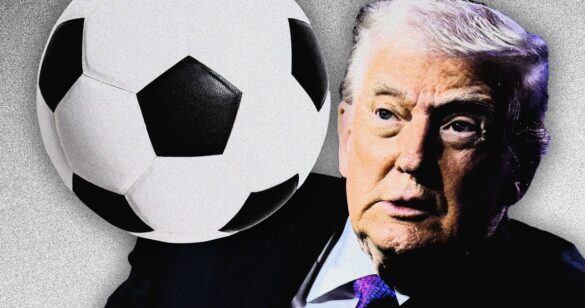

Photo-Illustration: Intelligencer; Photo: Getty Images
The 1980 United States men’s Olympic hockey team has enjoyed nearly five decades of valorization at this point, including dozens of documentaries, a well-regarded film adaptation starring Kurt Russell, and meetings with multiple presidents. So you can understand why Jack Hughes might have thought he’d cashed his ticket for a lifetime of deification. He had, after all, just scored the winning goal to clinch the gold medal for Team USA, its first men’s hockey gold since that 1980 team, and he’d done so after losing multiple teeth earlier in the game. This was all any American hockey player could dream of. He’d never have to buy a drink again. He’d be set for life.
He ended up being set for about, oh, two hours.
Then footage emerged of President Trump calling the team to congratulate them and everyone laughing along with a “joke” he told about having to invite the U.S. women’s hockey team (also gold-medal winning and much more dominant) to the White House. The fact that Kash Patel was smashing beers just a few feet away didn’t help. Hughes quickly went from being an American hero to yet another combatant in the never-ending culture war, to the point that when he appeared on Saturday Night Live less than a week after his goal, the reaction was notably muted compared with the massive pop the women’s team got when they came on right after. One can argue whether Hughes specifically deserved this reception — he is well known for being less overtly conservative and Trump supporting than almost every other U.S. men’s hockey player, and his mother is a famous hockey player who even worked for the women’s team this year — but it’s undeniable that if a documentary is ever made about this gold-medal-winning U.S. men’s hockey team, Donald Trump’s call and the firestorm that resulted will be right in the middle of it. We may end up remembering it much longer than Hughes’s actual goal.
Perhaps you read that sentence and thought, Good! He and his teammates did disrespect the women’s team, not to mention turn off millions of potential hockey fans who, spurred by the success of Heated Rivalry, were primed to give his sport a try. That’s not happening now. Serves him right.
Perhaps you read that sentence and thought, Cheering for sports teams always means having to cheer for people with personal or political views you abhor, and just because a bunch of Heated Rivalry fans thought that show meant hockey players were cool and progressive doesn’t mean they actually are. Cheering Hughes’s goal and being happy that Team USA won gold have nothing to do with how one thinks about Trump.
You can both be right, and you can both be wrong. But one thing is clear: This conversation — what it means to cheer for a national sports team, whether the players’ personal politics matter, what responsibility athletes have or do not have during a time of American-driven global strife — is not only not going away, it’s about to get a lot, lot louder. It has never truly been possible to separate politics from sports. But now it will be impossible even to try.
In three months, the World Cup — the biggest sporting event in the world, bigger than the Olympics, really — will take place across the United States (and parts of Canada and Mexico). And in two years, the Summer Olympics will take place in Los Angeles. There is zero question that Trump will put himself at the dead center of every aspect of both events, not just because that’s what he does but because they are happening in his backyard. That FIFA Peace Prize madness was merely the beginning.
Now that the hockey kerfuffle is mostly behind us and we’re back just talking about Connor Storrie like we’re supposed to, it’s worth looking at what we’ve learned from the USA Olympic hockey fiasco and what it augurs moving forward.
If we’ve learned anything from the first year-plus of Trump 2.0, it’s that he considers anything involving the United States to be his: something he owns and controls, an extension of himself. Every time he sees a flag, or an American athlete, or, like, a truck, he is going to make sure everyone who sees it thinks of him — and thinks he is in charge of it. The World Cup will be a vivid, overwhelming manifestation of this, with nearly every citizen on the planet, from every country and continent, at full attention. Trump does not care about soccer any more than he cares about hockey — no way could he name one single hockey player, men’s or women’s, other than Wayne Gretzky, and he surely knows even fewer soccer players — but every game played at every venue this summer will assuredly have his stamp on it. (It is widely assumed, thanks to his relationship with FIFA head Gianni Infantino, that Trump will deliver a message before the World Cup, one that may even be played before every game.) That Trump tarnished an all-time USA hockey win is irrelevant to him; all that matters is that he was center stage. He’ll make sure he continues to be.
As I’ve written before, this warmongering, global-bully version of the United States will become increasingly isolated on the global sports stage. This is not such a big deal at the Winter Olympics; there are very few Latin American or Middle Eastern countries that really compete much in the snow. But it’s going to be a huge problem at the World Cup. ICE has already promised a heavy presence at the event, to the point that many Latin American fan groups have made it clear they won’t be attending. But this extends to the athletes themselves. At the World Baseball Classic, which began this week, eight people involved with the Cuban team, including its pitching coach, were denied visas by the State Department. That will absolutely happen again this summer with countries like Colombia, Ecuador, Mexico, and Paraguay in the mix. There are in fact four countries competing — Iran, Ivory Coast, Haiti, and Senegal — that are part of Trump’s travel ban. Iran, for obvious reasons, seems most at risk of an absence; its first game is scheduled for June 15 against New Zealand at SoFi Stadium in Los Angeles. But Iran’s soccer-federation president has already said he “does not know” if the country’s team will compete, and Trump commented that he “really doesn’t care” one way or another. There is more of that to come.
It was strange, I have to admit, to feel a lot of national pride at these Olympics. Rooting for the individual athletes and their stories and their journeys wasn’t so hard, but that stirring “We did it, America!” thing that is a big part of international competition felt missing this time around. That’s going to be an even bigger issue for Team USA at the World Cup, particularly because the men’s team is traditionally an underdog on the world stage and it’s always much easier and inspiring to root for an underdog. (That’s why the 1980 men’s hockey team was so beloved; no one thought they could win. No one got emotional about the Michael Jordan–Larry Bird–Magic Johnson Dream Team winning a basketball gold medal; of course they won.) A common rallying cry among sports fans is “Us against the world.” That feels, uh, a lot different when you’re talking about the United States right now.
This is the ultimate legacy of the men’s hockey victory over Canada: Casual fans — and events like the Olympics and the World Cup bring out millions of casual fans, people who are new to this and haven’t had to go through the mental gymnastics of trying to be an ethical sports fan until now — will be a lot more careful giving their heart to an American athlete unless they can be sure that athlete won’t be yukking it up with Trump directly afterward. In the case of the U.S. men’s soccer team, I suppose I have some bad news for you about star Christian Pulisic right from the get-go. But you can feel better about Tim Weah and Weston McKinnie if you need to. And I suspect a lot of people will.
Look, I believe it is a moral responsibility of any citizen who is appalled by Trump and what he is doing to this country to stand up and say so — if just so future generations will be able to see that people were protesting. But that’s easy for me to do and say: I’m a guy who writes down my opinions online, so that’s sort of my job in the first place. You can understand why athletes — particularly those playing for a national team — would be more hesitant to do so, even if they wanted to. LeBron James spent a good portion of his NBA career as a Fox News villain; the U.S. women’s soccer team had conservatives actively cheering against them during the previous World Cup; U.S. skier Hunter Hess was attacked during the Olympics by Trump even though Hess had never said Trump’s name. When the Games were over, Hess actually called the Olympic fortnight “the hardest two weeks of my life.” That is not how an Olympian is supposed to feel about the event they trained their entire life for! You can hardly blame an athlete for keeping their mouth shut. But in an age when being familiar with an athlete’s political views becomes a prerequisite for many fans, silence can feel a little like complicity. Athletes can’t win for saying anything, and they can’t win for saying nothing. The thing about athletes is they generally like to win. Trump has made it impossible for them to do so.
Again: You cannot separate sports from politics because you cannot separate anything from politics. It’s all connected, whether we want it to be or not. But I will say that when you spend your time watching a sporting event wondering whether the person you’re cheering for is a supporter of a fascist regime, you are not, in fact, having a very good time. And sports is supposed to be a good time! This is supposed to be a diversion! We’re supposed to be enjoying ourselves! But this isn’t fun for the athletes, it’s not fun for those trying to make these games happen (and make money off them), and it’s certainly not fun for the fans. Do you want to tune out the noise of the madness of living in 2026 for a few hours and just enjoy a game? Do you want to escape? You can’t. Trump won’t let you. That was how it played out at the Winter Olympics, and that’s how it will be at the World Cup. Jack Hughes may indeed never have to pay for another drink the rest of his life. But if so … he better make sure he picks the right bars.
