
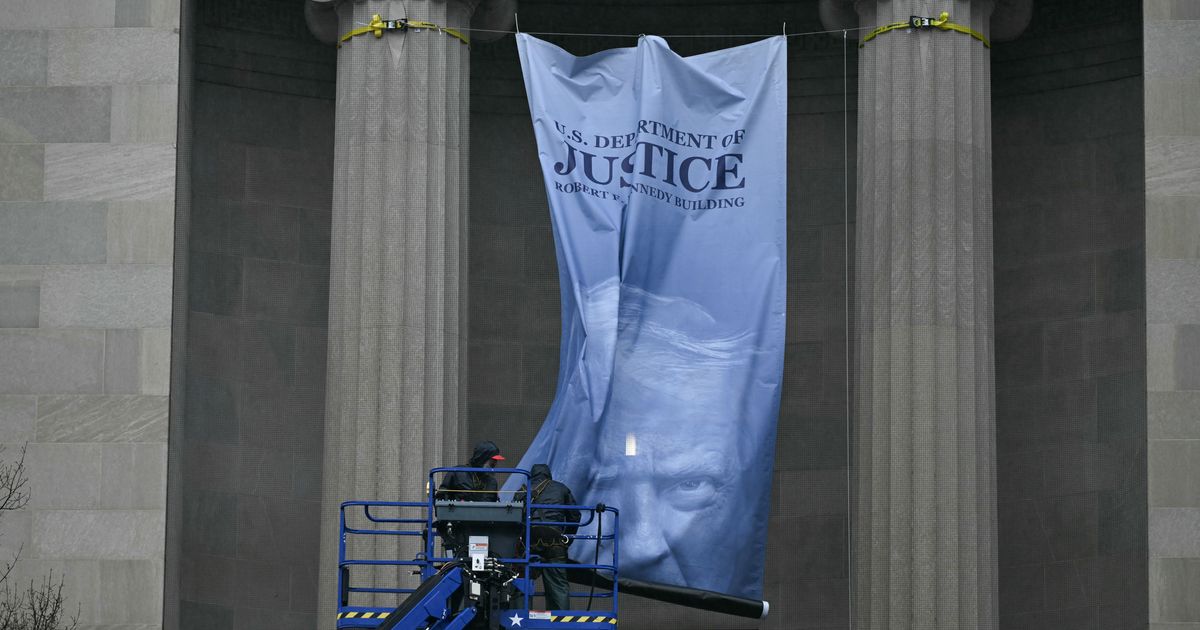

The DoJ apparently has better things to do.
Photo: Brendan Smialowski/AFP/Getty Images
The United States Department of Justice is getting lapped by both Congress and the British authorities on follow-up investigations around the Epstein files. There’s no excuse for either. As British police arrest astonishingly powerful men for their dealings with Jeffrey Epstein and the U.S. House of Representatives tries to force titans of finance and politics to answer tough questions, our Justice Department lags far behind. It’s not even clear the DoJ is doing anything at all.
Over in the U.K., law-enforcement officials have arrested former prince Andrew Mountbatten-Windsor and former ambassador to the U.S. Peter Mandelson. (Technically, both have been arrested but not yet formally charged, under a wrinkle in British legal procedure.) The putative defendants reportedly face potential charges of “misconduct in public office” for allegedly providing confidential government documents, including sensitive financial information about investment opportunities, to Epstein. (British authorities have accused neither man of participation in Epstein’s child sex-trafficking ring.)
The British case is based in part on emails contained in the U.S. Justice Department’s own Epstein files, which were released less than a month ago. In a matter of weeks, British police investigated and arrested a former prince (Andrew) and a lord (Mandelson); have subjected both men, and others around them, to extensive questioning; and have conducted searches at properties associated with the subjects. Meanwhile, the most memorable step taken by our Justice Department since the release of the files was Deputy Attorney General Todd Blanche’s public-service announcement that “the American people need to understand that it isn’t a crime to party with Mr. Epstein.”
The contrast extends to the tone at the top. King Charles — an actual monarch who wears a literal crown and carries a scepter to work — has told British investigators (in American parlance) to do what you gotta do. Or, in the proper King’s English: “What now follows is the full, fair and proper process by which this issue is investigated in the appropriate manner and by the appropriate authorities. In this, as I have said before, they have our full and wholehearted support and cooperation. Let me state clearly: The law must take its course.” Other heads of state should follow the king’s hands-off example — in a case against his own brother Andrew, no less.
Our own president isn’t quite of the same mind. He has long dismissed the Epstein case as a hoax, though it’s unclear what exactly he claims is fake. And he recently urged the American public to just get over it already. “I think it’s time now for the country to maybe get onto something else, like health care,” Trump responded when asked about the Epstein matter.
The DoJ has dutifully adopted Trump’s recommended approach: myopia blended with dissembling and a pinch of proactive excuse-making. As Blanche explained earlier this month, “There’s a lot of correspondence. There’s a lot of emails. There’s a lot of photographs. But that doesn’t allow us necessarily to prosecute somebody.” Not exactly the tenacious prosecutorial posture Blanche and I learned during our concurrent early days at the Southern District of New York. But hey, if our Justice Department isn’t going to make meaningful use of its own Epstein files, at least others will.
And then there’s Congress, which has taken a flawed but aggressive approach to its Epstein investigation. While a bipartisan (but mostly Democratic) coalition of lawmakers forced passage of the Epstein Files Transparency Act, the Republican-led House Oversight Committee has pressed forward with a series of aggressive subpoenas for testimony. Yes, the subpoenas are largely for political show, and no, the House has not extracted any damning admissions — but it’s putting powerful people on the spot and making them face meaningful questioning under oath.
Last week, billionaire Les Wexner — whose name the DoJ originally redacted from a document listing him as an unindicted “co-conspirator” but then unredacted after Representative Thomas Massie publicly called out the redaction — faced five hours of questioning from the Oversight Committee. Wexner, a close associate of Epstein’s, claimed no knowledge of his friend’s criminality. Wexner also denied allegations that he had sexually abused Virginia Giuffre, who testified in 2016 that, as a minor, she had been trafficked to have sex with Wexner multiple times. (She died by suicide in 2025.)
The beauty of being a federal prosecutor is you don’t have to take a blanket denial as the final word, even from an arrogant billionaire. People disclaim wrongdoing all the time. Sometimes they’re telling the truth; other times they aren’t. So ordinarily, given the lead provided by Congress, DoJ prosecutors may take Wexner’s testimony and subject it to rigorous testing — talk to other witnesses, examine emails and texts, check out phone, financial, and travel records. Yet we’ve seen no indication of DoJ doing any such thing.
This week, the Clintons take their turn at the Oversight Committee’s deposition table. After a prolonged back-and-forth during which they played themselves into a strategic corner, the former First Couple relented and agreed to testify under the looming threat of a contempt-of-Congress charge supported by some bipartisan votes.
The Hillary Clinton subpoena was an obvious stretch by a congressional committee seeking to drag in a boldface name. She had nothing to do with Epstein; the best that Republican committee chair James Comer could do in defense of the subpoena was to note that — brace yourself — Clinton had hired Ghislaine Maxwell’s nephew to work on her 2008 presidential campaign and later at State. Yes, that’s the headliner. Clinton proceeded to tear the committee a new one with her opening statement on Thursday and, predictably, nothing of relevant substance came of her testimony.
But Bill Clinton will have to squirm when he answers questions today. The committee surely will confront the former president — a frequent flier on Epstein’s private jet — with photographs that show him partying with Epstein (not a crime, remember, per the deputy AG); swimming in a pool with Maxwell and a female whose identity has been redacted, and reclining in a hot tub at night, hands behind his head, along with a female whose image has been blacked out.
Meanwhile, we’ve seen no sign that the Justice Department has subpoenaed or otherwise sought to interview Wexner or Clinton or any other powerful Epstein associate — and certainly not the most powerful of all former Epstein pals, Trump himself. (Notably, even the aggressive House Oversight Committee hasn’t sought testimony from the current president.)
The DoJ’s apparent inaction is particularly galling given that prosecutors hold far more potent investigative tools than Congress does. Prosecutors have the vast resources of the Justice Department and FBI at their disposal, while Congress must make do with minimal investigative staff. Prosecutors can obtain search warrants and wiretaps, while Congress can’t. And prosecutorial subpoenas generally can be broader in scope than congressional subpoenas and are enforced more rigorously by the courts.
The Justice Department has been flailing for months now to justify its inactivity. Back in July 2025, top DoJ officials released a memo declaring that, after an exhaustive review of over 300 gigabytes of information, “We did not uncover evidence that could predicate an investigation against uncharged third parties.”
Since then, the Justice Department has offered mixed messages (at best) about its ongoing investigative efforts. And while prosecutors could be moving stealthily behind the scenes, entirely undetectable to the public — I’m dubious, but it’s possible — we’ve seen zero public indication of actual in-the-field enforcement activity: no search warrants, no subpoenas, no interviews with key players, no arrests.
Meanwhile, the British authorities and Congress forge ahead. It’s an embarrassing moment for our Justice Department’s leadership and a telling indictment of its own stubborn — and perhaps purposeful — indifference.
